GUIDE
Prepare your IFS Food audit: the Tracklab practical guide, 2026 edition.
Download the guide →Guide pratique IFS Food : préparez votre audit avec Tracklab
Indiquez vos coordonnées pour télécharger le document.
✓ C’est prêt
Le fichier s’ouvre dans Google Drive : vous pouvez le télécharger ou l’imprimer.

Digital Transformation
Updated on
11/18/2026
23/11/26
LIMS definition: uses and limitations in the food industry
What a LIMS is, what it manages in the lab, what it doesn't cover for manufacturers, and how to process the compliance of received analyses.

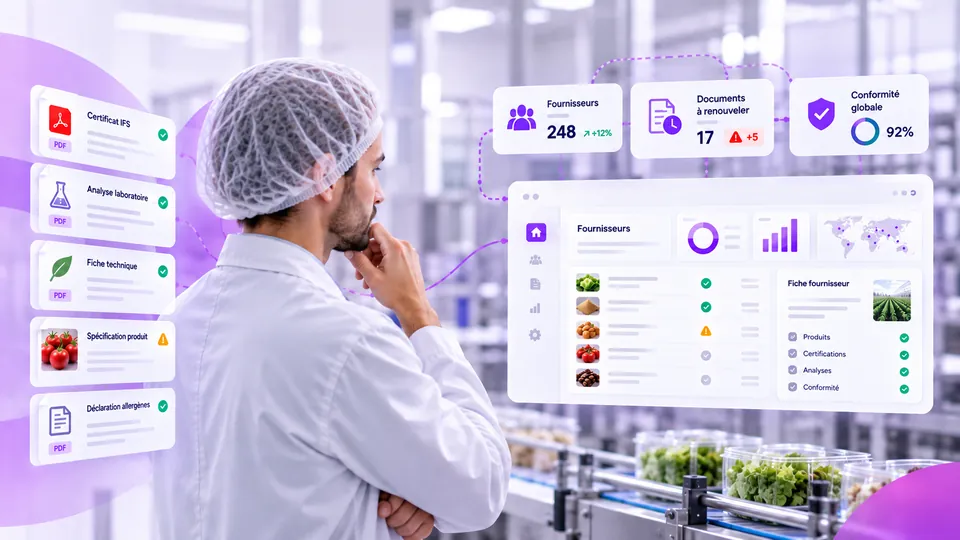
LIMS definition: a Laboratory Information Management System is the software that manages the lifecycle of a sample within a testing laboratory: logging requests, applying methods, recording and calculating results, tracking instruments, and issuing certificates of analysis. It primarily serves the laboratory that generates the analytical results. This page defines what it is, its use cases, and its limitations, and then explains what food manufacturers need when they receive these results and must cross-reference them against their own specifications.
In brief
- A laboratory LIMS manages analyses within the lab that produces them. It does not collect analyses that you receive from your suppliers, external labs, or other group sites.
- Its functions are limited to the sample, method, result, instrument, and report. It does not hold your client specifications or your supplier database.
- In the quality chain, each tool answers a different question: the LIMS produces the measurement, the QMS manages procedures and deviations, the ERP handles flows, and the PIM manages product information.
- On the industrial side, the need is different: to gather all received reports, compare them to regulations and your own thresholds, and keep a record of every calculation.
- This is what Tracklab does, a LIMS software designed for manufacturers who receive analyses: the platform calculates the compliance status and keeps it traceable and auditable. The decision to accept, reject, or audit remains with your quality teams.
What is a LIMS? Definition and scope
A LIMS is a sample-centric laboratory management software. It records the analysis request, applies the planned method, collects and calculates the result, tracks the instrument that produced it, generates the report, and archives the corresponding records. Its classic scope is limited to the laboratory performing the analysis.
What exactly does the acronym LIMS stand for?
LIMS stands for Laboratory Information Management System. The acronym refers to a category of tools, not a specific brand, standard, or framework. There is no single normative definition establishing mandatory LIMS features: two tools within the same category can cover vastly different scopes.
This is why the question "what is a LIMS?" is poorly answered by a generic list. The right approach is to start from the functions actually used: sample types, methods, instruments, report generation, access rights management, and audit trails. Or, on the industrial side, received analyses and the requirements to apply to them.
What is a LIMS compared to laboratory management software?
Both expressions refer to the same thing: "laboratory management software" is the standard translation of LIMS. A laboratory LIMS is therefore not a sub-category.
However, three related families should be distinguished:
- the LIMS, which manages the sample and the result;
- the Electronic Lab Notebook (ELN), which records protocols and tests as they happen;the
- document management software, which stores and distributes quality documents without processing results.
A manufacturer receiving analysis reports rarely needs the first two. Their need is to reconcile results already produced with their own set of requirements: this is the industrial use of a LIMS, described below.
What is a LIMS used for in an analysis laboratory?
A LIMS is used to enable a laboratory to produce a reliable result and then retrieve it months or years later. It organizes four flows: the request, the analysis, the instrument, and the record.
The functions that a laboratory LIMS actually covers
- Registration of samples and analysis requests, with identification, status, and recipient.
- Assignment of methods and operating procedures to each type of analysis.
- Entry, calculation, and verification of results, with an audit trail that keeps the author, date, and previous value.
- Tracking of instruments, calibrations, consumables, and associated deadlines.
- Generation of analysis reports and archiving of records.
- Management of rights, profiles, and internal review workflows before distribution.
The functions that a laboratory LIMS does not cover
- The supplier database: identity, regulatory documents, deadlines, history.
- The contractual thresholds, negotiated client by client and sometimes stricter than regulations.
- The collection of reports issued by third parties, which arrive in PDF, by email, in formats and languages that change from one issuer to another.
- Multi-site and multi-supplier consolidation over several years.
- The decision: accepting raw material, opening a deviation, reviewing a supplier, initiating an action.
This distribution is not a criticism. A laboratory LIMS is designed for a laboratory, with its own specific constraints: methods, metrology, and record integrity. Asking it to carry the industrial manufacturer's reference system is like entrusting it with a job that is not its own.
Why is a laboratory LIMS not enough for a food industry manufacturer?
For a manufacturer, a significant portion of results does not originate in their own laboratory. It comes from third parties, and this is precisely what neither the internal LIMS nor the service provider's LIMS covers.
Where do the analyses you need to reconcile come from?
- The certificate of analysis attached by the raw material or ingredient supplier.
- The report from an external laboratory commissioned for a monitoring campaign.
- The results of self-checks performed at the production site.
- The counter-analysis requested after a questionable result.
- The analyses required by a client or distributor before listing.
These documents circulate in email inboxes and shared folders. The internal laboratory's LIMS does not see them; the service provider's LIMS knows neither your clients nor your product tolerances. And the conclusion printed by each laboratory is based on its own references, not necessarily yours.
Which requirements must you reconcile with these results?
Four European texts structure the bulk of comparisons in the food industry, and two define the general framework in which they operate.
| Texte | Ce qu'il fixe | Ce que vous devez rapprocher |
|---|---|---|
| Règlement (CE) n° 178/2002, art. 17 et 18 | Responsabilité des exploitants du secteur alimentaire, traçabilité en amont et en aval | L'identification du fournisseur et de la référence produit à l'origine de chaque résultat |
| Règlement (CE) n° 852/2004, art. 5 | Procédures permanentes fondées sur les principes HACCP, avec tenue d'enregistrements | La surveillance des points critiques et les enregistrements associés |
| Règlement (CE) n° 2073/2005 | Critères microbiologiques de sécurité et d'hygiène des procédés, par catégorie de denrée | Les critères microbiologiques applicables à votre famille de produits |
| Règlement (CE) n° 396/2005 | Limites maximales de résidus (LMR) de pesticides par denrée et substance active | Les LMR des matières premières végétales reçues |
| Règlement (UE) 2023/915, qui remplace le règlement (CE) n° 1881/2006 | Teneurs maximales en contaminants (mycotoxines, métaux, etc.) | Les seuils par contaminant et par catégorie de denrée |
| Règlement (UE) n° 10/2011 | Matériaux plastiques au contact des denrées : migration globale et limites spécifiques | Les résultats de migration des emballages et ustensiles |
Three precautions apply to all these texts:
- The applicable version is the one in force on the date of sampling: their annexes are updated regularly, and a threshold applied to an old version produces a false status.
- The regulatory limit is not the contractual threshold: a client can demand better than the law, never less.
- The source of the threshold must be kept with the result: it is this pair that makes a status defensible in supplier reviews as well as in audits.
Added to this are your client specifications, your internal specifications, and private distribution standards (IFS Food, BRCGS), whose requirements focus on document control and product monitoring.
Does a laboratory's ISO/IEC 17025 accreditation tell you if the result is compliant?
No, and this is a common misconception. Accreditation to ISO/IEC 17025 confirms a laboratory's competence for the specific methods covered by its scope of accreditation. For official laboratories conducting official controls, Regulation (EU) 2017/625 requires accreditation to EN ISO/IEC 17025 under Article 37, while Article 34 governs sampling and analysis methods.
In other words: accreditation tells you how the measurement was obtained. It says nothing about whether that measurement complies with your contractual threshold, for your product, for your customer.
What are the limitations of a laboratory LIMS regarding supplier data?
A laboratory LIMS can compare a result to a specification entered for the analyses it hosts. The comparison stops there, and several structural needs remain unaddressed.
| Besoin | LIMS de laboratoire | LIMS côté industriel (Tracklab) |
|---|---|---|
| Collecter un bulletin émis par un tiers | Rarement, et sans structuration | Oui : adresse dédiée, portail fournisseur ou dépôt direct |
| Extraire paramètre, valeur, unité, LQ et méthode | Sur les analyses saisies en interne | Oui, par lecture automatique, en français, anglais, allemand, turc ou chinois |
| Rattacher le résultat au fournisseur et au produit | Partiel | Oui |
| Comparer aux seuils réglementaires | Selon le paramétrage | Oui : quatre textes européens intégrés et maintenus par Tracklab |
| Comparer à un seuil contractuel ou interne | Non prévu par défaut | Oui, avec un seuil de vigilance et un seuil bloquant |
| Historiser le statut de conformité dans le temps | Sur les analyses internes | Oui, avec le seuil, le texte, la version et la date appliqués |
| Décider d'accepter, d'écarter ou d'auditer | Non | Non : le statut est calculé, la décision reste à vos équipes |
Three blind spots that cost time
- 1. Collection. As long as reports arrive as attachments, someone has to open, name, and file them. This time produces no decision.
- 2. The threshold. A threshold copied from one spreadsheet to another, without a source or application period, eventually corresponds to nothing.
- 3. History. A supplier drift cannot be read in an isolated report: it appears over twelve months, provided that the results are stored in a comparable way.
Where does a LIMS fit into the quality chain, alongside the QMS, ERP, and PIM?
An analysis result only has operational value if it is linked to the systems that describe the product, the procedure, and the flow. Each answers a different question.
| Outil | Question à laquelle il répond | Ce qu'il héberge | Ce qu'il ne porte pas |
|---|---|---|---|
| LIMS de laboratoire | Quelle valeur a été mesurée, par quelle méthode, sur quel échantillon ? | Échantillons, méthodes, résultats, instruments | Vos cahiers des charges clients |
| QMS (système de management de la qualité) | Quelles règles s'appliquent, quels écarts, quelles actions ? | Procédures, non-conformités, actions correctives, audits | La mesure elle-même |
| ERP (progiciel de gestion intégré) | Quels flux, quels stocks, quels coûts ? | Commandes, réceptions, stocks, facturation | Les seuils qualité par paramètre |
| PIM (gestion des informations produit) | Quelles caractéristiques produit sont communiquées ? | Fiches produits, allégations, informations réglementaires | Le résultat d'analyse et son statut |
| LIMS côté industriel (Tracklab) | Ce résultat respecte-t-il la réglementation et mes exigences, et selon quoi ? | Bulletins reçus, référentiels, seuils, statuts, historique | La décision et la procédure qualité |
A detailed comparison of these tools is available on our page about the differences between LIMS, ERP, and QMS.
LIMS and QMS: measurement on one side, non-compliance on the other
A QMS defines what the organization aims to do: specifications, responsibilities, deviation management, and internal audits. A LIMS records what was actually measured. The two intersect when an out-of-spec result becomes a non-conformance: the LIMS supplies the value and its context, while the QMS manages the root cause analysis and corrective action. Our page on non-conformance management in the food industry explores this transition in detail.
LIMS and ERP: flow and measurement
An ERP tracks which quantities were ordered and received; it does not know whether a measured ingredient value meets agreed specifications. This relationship is detailed in ERP and supplier data.
LIMS and PIM: results and product specifications
A PIM publishes product specifications to customers and retailer portals. It relies on accurate, up-to-date data, but is not designed to store certificates of analysis or their compliance status. The page on our integrated QMS, LIMS, and PIM platform illustrates how this information flows.
LIMS in the food industry: what are the use cases for quality, purchasing, and laboratory teams?
A food industry LIMS is not a distinct technical category. What changes in this sector is the volume of externally produced results and the diversity of thresholds to be applied.
Quality teams: a ready-to-use file, not one that needs reconstructing
The expected use is simple: knowing, material by material, what is compliant, what is on alert, and what requires a decision, without having to reconstruct the file for every audit. This assumes that each status remains linked to its source document and the version of the threshold applied.
Purchasing: making supplier reviews objective
A documented trend over several months reshapes your annual review: the discussion shifts from an isolated incident to a recurring pattern. The supplier audit process relies on the exact same supporting data.
Laboratory: keep the lab LIMS for what it does best
For on-site analyses, the laboratory LIMS remains the reference tool: samples, methods, instruments, and reports. The right question is not how to replace it, but how to decide how its results join those received from outside in a shared history.
Five questions to ask before choosing a LIMS
1. Do you perform the analyses, or do you receive them?
2. What proportion of your results comes from suppliers and external laboratories?
3. Which thresholds must you apply: regulatory, contractual, or internal?
4. Do you need to be able to retrieve the threshold applied at a given date?
5. Who makes the decision in the event of a discrepancy?
See the guide to choosing LIMS software
From an industrial perspective: what Tracklab does with the analyses you receive
Tracklab is LIMS software designed for the manufacturer receiving analyses, not for the laboratory producing them. The platform works with reports that have already been issued, in five steps.
- 1. Collection. Reports arrive via a dedicated email address, through the supplier portal, or by direct upload.
- 2. Extraction. The platform reads the document—in French, English, German, Turkish, or Chinese—and extracts the parameter, value, unit, LOQ, and method. Each parameter is recognized regardless of its label, and a "not detected" result remains recorded information.
- 3. Linking. Each report is associated with the relevant supplier and product.
- 4. Comparison. Each result is compared against the applicable standards: four European texts integrated and maintained by Tracklab, as well as your own standards (internal policy, customer specifications), with both a warning threshold and a blocking threshold.
- 5. Calculation and archiving. Each parameter is assigned a status: compliant, alert, non-compliant, or "to be determined" with a reason provided when information is missing. It is displayed alongside the laboratory's conclusion and retains the threshold, text, version, and date applied: the tracking is traceable and auditable.
Tracklab calculates and tracks; final sign-off remains with your quality teams. To learn more about this module, visit Tracklab's LIMS software page, or book a meeting with a Tracklab expert to run calculations on your own certificates of analysis.
Frequently asked questions
What is a LIMS in one sentence?
A LIMS is software that manages the samples, methods, results, and instruments of an analytical laboratory, from sampling to report generation. From an industrial perspective, the term also refers to the tool that gathers received analyses and calculates their compliance with company requirements.
Is a LIMS mandatory in the food industry?
No European text mandates a LIMS. What the regulatory framework requires concerns results and their traceability: identifying suppliers and recipients (Regulation (EC) No 178/2002, Art. 18), and implementing procedures based on HACCP principles while maintaining records (Regulation (EC) No 852/2004, Art. 5). The tool remains an organizational choice.
Can a LIMS track my suppliers' analyses?
A laboratory LIMS can do so only partially: it does not collect reports issued by third parties and does not manage contractual thresholds per client. An industrial-side LIMS, like Tracklab, is designed for this: it gathers reports from suppliers and external laboratories and calculates their compliance with your standards.
How can I reconcile an analysis report with my requirements?
By keeping four pieces of information for each result—the measured value with its unit, the relevant parameter, the applicable threshold with its source and version, and the sampling date—the comparison becomes reproducible, whether performed manually or by software.
What is the difference between LIMS, QMS, ERP, and PIM?
A laboratory LIMS produces the measurement, the QMS manages procedures and deviations, the ERP tracks flows and inventory, and the PIM publishes product information. None of these systems natively compare results received from third parties against customer-specific contractual thresholds: that is the role of an industrial-side LIMS.
Next steps
- 1. List the five analysis parameters that take up the most time for manual verification.
- 2. For each one, gather the applicable threshold, its source, and its effective date.
- 3. Identify the portion of these results produced outside your laboratory: this is the scope that a laboratory LIMS does not cover.
- 4. Run the calculation on three actual reports, then compare it with your current process.
Book a meeting with a Tracklab expert to walk through these steps across your operations. To compare solutions, check out our guide to choosing a LIMS software.
About the author
Gautier Veysset, industry specialist writer at Tracklab. LinkedIn profile
Take control of your supplier data.
See how Tracklab centralizes, validates and keeps your supplier and product data up to date, so your teams can work faster with reliable information.
See Tracklab in action
Our latest news


Platform
Resources
You have subscribed to our newsletter thank you!
Something went wrong while submitting the form. Please try again.