

Supply Chain
Mis à jour le
9/14/2026
14/9/26
Regulatory supplier traceability: complete guide
Everything manufacturers need to know about regulatory supplier traceability: the EC 178/2002 legal framework, mandatory documentation, operational challenges, and how AI can ensure compliance.


In short
- Regulatory traceability is a legal obligation for all food and manufacturing operators: it requires companies to be able to identify suppliers, batches and customers at every stage of the chain.
- Regulation (EC) No 178/2002, Article 18, forms the foundation of the European legal framework. It is supplemented by sector-specific regulations such as Regulation (EU) No 931/2011 for food of animal origin and Regulation (EU) 2017/745 for medical devices.
- Effective traceability relies on 5 types of supplier documents: product specifications, supplier specifications, Certificates of Analysis (CoA), declarations of conformity and control plans.
- The 4 main operational challenges are document fragmentation, manual follow-ups, audit readiness and batch management in the event of a recall.
- AI can now automate critical data extraction, trigger proactive alerts for expired documents and maintain a real-time audit trail.
- In 2024, 2,101 food recalls were published on RappelConso in France, representing a 14% increase in one year — a reality that makes document traceability more important than ever.
1. What Is Regulatory Traceability? Definition and Legal Framework Under Regulation (EC) No 178/2002
In a sector where product safety directly engages companies’ civil and criminal liability, regulatory traceability is not simply a matter of convenience: it is an obligation to achieve a result. Understanding exactly what it covers — and what it requires — is the first step toward building a robust system.
Official definition. Regulation (EC) No 178/2002 of the European Parliament and of the Council, also known as the General Food Law Regulation, defines traceability in Article 3 as:
“The ability to trace and follow a food, feed, food-producing animal or substance intended to be, or expected to be, incorporated into a food or feed, through all stages of production, processing and distribution.”
Article 18 of the same Regulation establishes the general obligation: every food business operator must be able to identify any person who has supplied them with food, feed or a substance intended to be incorporated into food, and must make this information available to the competent authorities upon request. This traceability obligation applies to every link in the chain, without exception.
Beyond the food industry, Regulation (EU) 2017/745 requires medical device manufacturers to implement a Unique Device Identification system (UDI) that guarantees traceability of each batch throughout the distribution chain — a requirement managed in France by the ANSM.
1.1 Upstream, Internal and Downstream Traceability: The 3 Levels to Master
Regulatory traceability is not limited to an inbound register. It is structured around three complementary levels that should be clearly distinguished:
- Upstream traceability — Identifying the origin of every raw material, ingredient or component received: which supplier, which batch and which date of receipt. This is the minimum level required under Regulation (EC) No 178/2002.
- Internal traceability — Tracking product transformation within the facility: which incoming batches were used to manufacture which outgoing batch, on what date and on which production line. Although it is not strictly mandatory under the Regulation, it is strongly recommended by the DGAL and is essential for managing a targeted recall.
- Downstream traceability — Identifying the professional customers to whom each batch was delivered, so they can be alerted quickly in the event of a non-conformity. Together, upstream and downstream traceability form the backbone of any withdrawal and recall plan.
Key takeaway: Regulations do not impose a specific format. They impose an obligation to achieve a result: companies must be able to provide the required information to the authorities within very short timeframes, often 24 to 48 hours in the event of a crisis.
1.2 Legal Obligations by Sector: Food and Manufacturing
Requirements vary depending on the industry. Here are the main regulations to know.
Food sector
- Regulation (EC) No 178/2002: requires upstream and downstream traceability for all food and feed business operators.
- Regulation (EU) No 931/2011: introduces enhanced traceability requirements for food of animal origin, including information on the dispatching establishment, batch and date.
- Hygiene Package — Regulations (EC) No 852/2004 and No 853/2004: integrates traceability into HACCP plans.
- Data retention period: the DGAL recommends retaining data for at least 5 years from manufacture or delivery.
Manufacturing and medical devices
- Regulation (EU) 2017/745: requires unique device identification (UDI), retention of traceability data throughout the distribution chain and communication obligations to the ANSM.
- ISO 9001 and ISO 13485: include document traceability requirements within quality management systems.
- REACH and CLP: require traceability of chemical substances in industrial products.
2. The 5 Essential Regulatory Documents for Complete Supplier Traceability
In a market where inspections are increasing and authorities can request evidence at any time, document traceability is critical. Here are the 5 types of documents that manufacturers need to collect, centralize and keep up to date for each active supplier.
| Document | Key content | Update frequency |
|---|---|---|
| Product specification | Composition, allergens, nutritional values, storage conditions | Whenever the formulation changes |
| Supplier specification | Quality specifications, regulatory requirements, control criteria | Annually or whenever revised |
| Certificate of Analysis (CoA) | Microbiological results, physicochemical results, contaminants | For each delivered batch |
| Declaration of conformity | Statement of compliance with applicable standards and regulations (CE, REACH, etc.) | Annually or upon each renewal |
| Control plan / supplier audit | Control frequency, acceptance criteria, audit results | Annually |
2.1 Product Specifications and Supplier Specifications
The product specification is the reference document that precisely describes the product delivered by the supplier: composition, allergens, nutritional values, transport and storage conditions, and minimum shelf life. It forms the basis of upstream traceability: without an up-to-date product specification, it is impossible to verify that the product received matches the contractual requirements.
The supplier specification goes further: it formalizes the buyer’s requirements, control criteria upon receipt, the supplier’s documentation obligations, the frequency of CoA submission, response times in the event of a non-conformity and batch traceability requirements. A well-written supplier specification is one of the first lines of defense against disputes during a traceability audit.
Key points to monitor:
- Check that the product specification is signed and dated by the supplier.
- Make sure the version number is tracked through proper version control.
- Include a mandatory update clause in the event of a formulation change or a change involving a tier-two supplier.
2.2 Certificates of Analysis (CoA) and Declarations of Conformity
A Certificate of Analysis (CoA) is the document proving, batch by batch, that the delivered product complies with the microbiological, physicochemical and regulatory criteria defined in the supplier specification. It is one of the documents most frequently requested during a traceability audit or recall investigation.
A declaration of conformity, on the other hand, is a statement from the supplier confirming that its products comply with applicable regulations such as CE requirements, REACH and requirements relating to prohibited substances. It is often required annually and should be renewed whenever a major regulatory change occurs.
Recommended regulatory retention periods:
2.3 Regulatory Retention Periods
There is no single retention period set by regulation, but DGAL recommendations and industry best practices generally converge around the following periods:
| Document type | Recommended minimum retention period | Regulatory basis |
|---|---|---|
| Upstream / downstream traceability data | 5 years | DGAL / Regulation (EC) No 178/2002 |
| Certificates of Analysis (CoA) | 5 years, or product shelf life + 1 year | Industry best practices |
| Supplier product specifications | Duration of the commercial relationship + 5 years | ISO 9001 / best practices |
| Declarations of conformity | 5 years after the end of commercialization | Regulation (EU) 2017/745 — medical devices |
| Supplier audit results | 5 years | IFS / BRC / ISO 22000 |
| Batch traceability data | Product shelf life + at least 6 months | Regulation (EC) No 178/2002 |
Practical tip: Set automated alerts 3 months before each document expires to avoid supplier compliance gaps. This is precisely what document management platforms such as Tracklab enable by triggering proactive follow-ups as soon as a document approaches its expiration date.
3. The 4 Operational Challenges of Regulatory Traceability
In an increasingly regulated environment, most manufacturers do not lack commitment to compliance — they lack organization. Regulatory traceability rarely fails in principle; it fails in day-to-day execution. Here are the 4 challenges quality and procurement teams consistently face.
3.1 Document Fragmentation and Version Control
The first challenge is structural: supplier documents arrive by email, supplier portal, post, as unstructured PDFs and sometimes in several languages. They are stored in shared folders, individual inboxes and ERP systems that are not designed for detailed document management.
As a result, when an auditor asks for the CoA for batch X delivered on March 15, finding it can take hours — or even reveal that the document simply does not exist.
Version control makes the problem worse: an updated product specification sent by a supplier without formal notification can coexist with the previous version in internal systems. The company may unknowingly continue working with outdated data, creating a potential non-conformity during an audit.
Practical consequences:
- Inability to respond quickly to authorities during an inspection.
- Risk of working with outdated specifications.
- Significant time wasted by quality teams during audit preparation.
3.2 Manual Follow-Ups and Supplier Delays
The second challenge is human: collecting documents from suppliers is time-consuming, repetitive and low-value work. Quality teams spend a significant amount of time following up with suppliers who have not submitted their CoA, annual declaration or updated product specification.
With a supplier base of 50, 100 or 200 references, this manual process becomes impossible to manage efficiently. Delays increase, documents expire without anyone noticing and regulatory compliance deteriorates silently — until the next audit or incident.
Indicative figures:
- A quality manager in a food industry SME may spend up to 30% of their time collecting and monitoring supplier documentation.
- A single expired document that goes undetected may be enough to trigger a critical observation during an IFS or BRC audit.
3.3 Audit Readiness: Being Ready at All Times
The third challenge is continuous preparedness. Certification audits such as IFS Food, BRC and ISO 22000, as well as official inspections by DGAL and DGCCRF, may take place with little or no notice.
Audit readiness — the ability to immediately provide evidence of compliance — has become a de facto requirement.
Yet in most organizations, preparing for an audit requires several people working for several days: collecting missing documents, checking expiration dates and reconstructing batch history. This preparation time is wasted time — and a sign that the document traceability system is not robust enough.
What auditors systematically check:
- Upstream traceability: can the supplier and batch be identified for every raw material used?
- Downstream traceability: can the customers who received a given batch be identified?
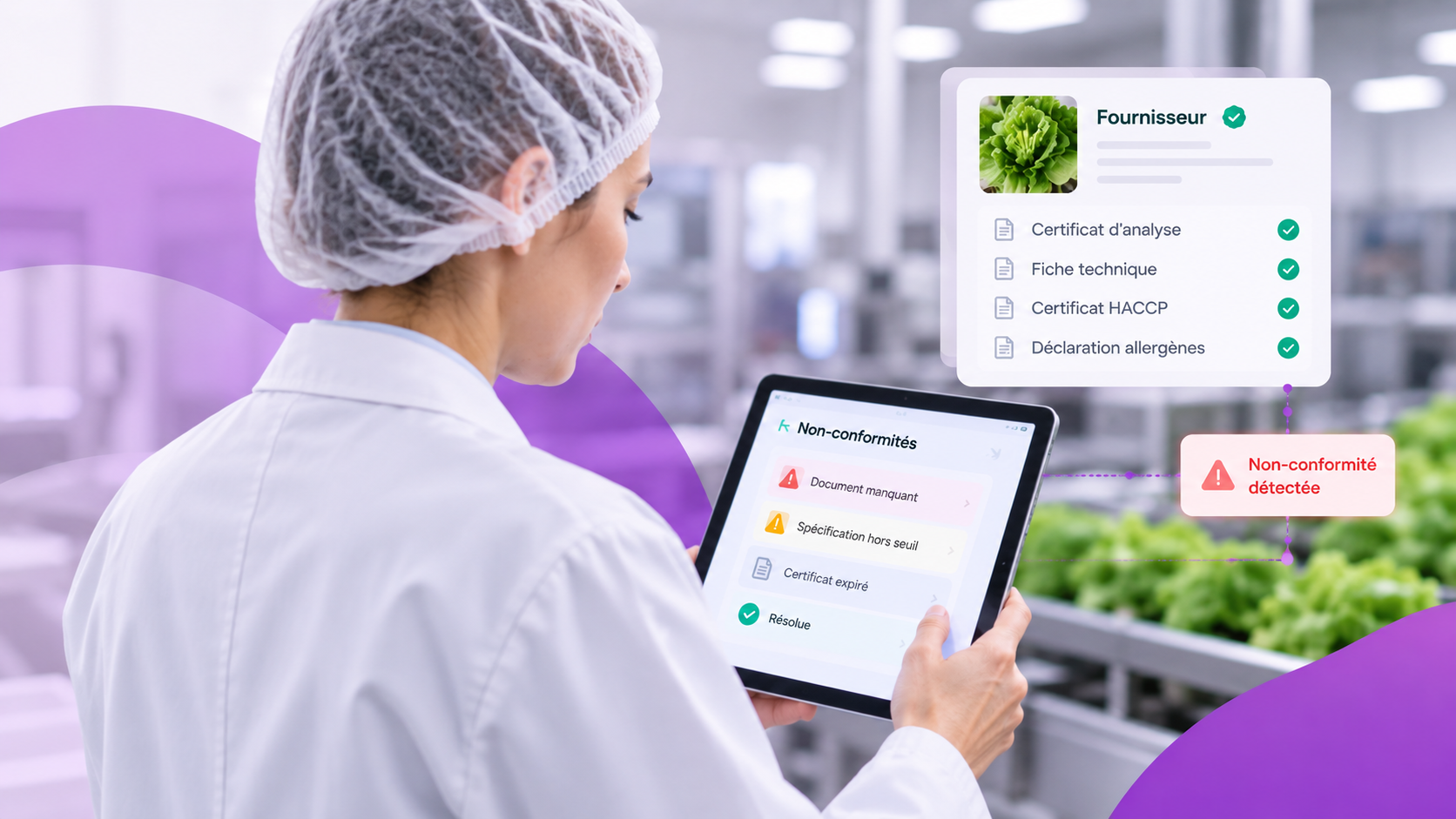
- Document completeness: are all required documents present, valid and accessible?
- History of non-conformities and corrective actions.
3.4 Batch Traceability in the Event of a Product Recall
The fourth challenge is the most critical: managing a product recall.
In 2024, 2,101 food recall notices were published on RappelConso in France, representing a 14% increase compared with 2023. Every recall engages the company’s responsibility and requires a fast, documented response.
Practical scenario — a real-life recall:
A food manufacturer receives an alert from its flour supplier: one batch may be contaminated with ochratoxin A. Within less than 48 hours, the company must identify all finished-product batches manufactured using that flour, list the professional customers to whom those batches were delivered, initiate the withdrawal or recall and inform the authorities.
Without structured and centralized batch traceability, this operation may take several days — during which potentially unsafe products remain in circulation. With a real-time traceability system, the same operation can be completed within a few hours.
Batch traceability is therefore not only a regulatory obligation: it is a crisis management tool whose effectiveness is measured in hours.
4. How AI Is Transforming Supplier Regulatory Traceability
As document volumes continue to increase and regulatory requirements become stricter, manual approaches are reaching their limits.
Artificial intelligence is opening a new era for supplier regulatory traceability: one that is no longer reactive and labor-intensive, but proactive and automated.
4.1 Automatic Extraction of Critical Data
The first major change enabled by AI is the automatic extraction of data from unstructured documents.
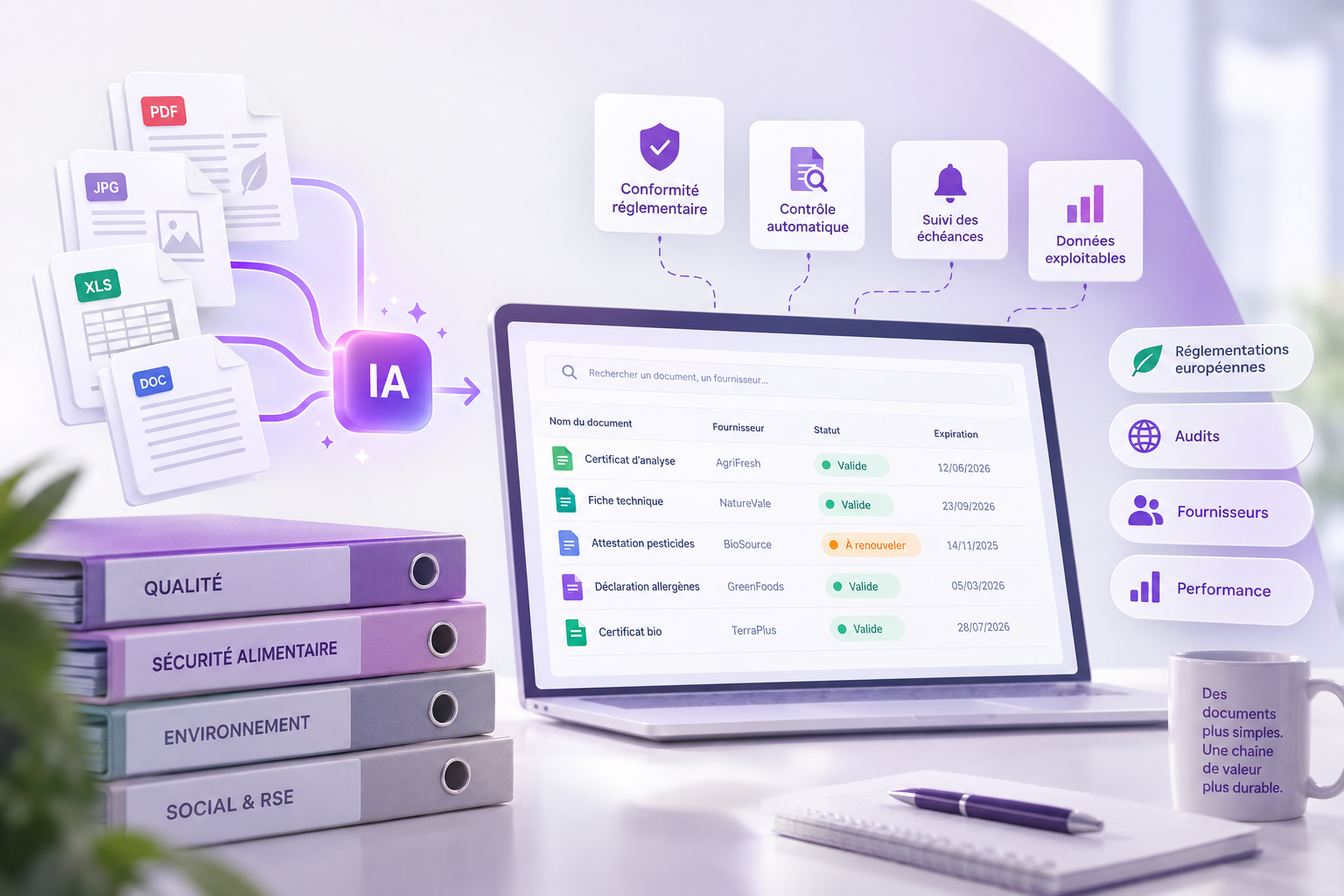
A Certificate of Analysis received as a PDF, a product specification written in English or a scanned declaration of conformity can be read by AI, which can then extract the critical information — batch number, expiration date, analytical values and declared allergens — and integrate it directly into the supplier repository.
What previously required 10 to 15 minutes of manual data entry per document — with all the associated risks of error — can now be completed within seconds. Quality teams can focus on analysis and decision-making rather than data entry.
Data that AI can automatically extract:
- Batch numbers and manufacturing / expiration dates.
- Analytical values such as contaminant levels and microbiological parameters.
- Allergen declarations and composition data.
- Regulatory references and certifications mentioned.
- Laboratory details and accreditation numbers.
Tracklab integrates this AI extraction engine directly into its document collection workflow, allowing every received document to be automatically structured and indexed without manual intervention.
4.2 Proactive Alerts for Expired Documents
The second contribution of AI is continuous monitoring of document status.
Instead of discovering an expired document during an audit, an intelligent system continuously monitors validity dates across the entire document portfolio and triggers proactive alerts at D-90, D-30 and D-7.
These alerts are automatically sent to the quality manager and, where necessary, directly to the relevant supplier through a dedicated portal.
The supplier receives a notification requesting the updated document, with a direct link to upload it. Follow-ups are automated, reminder history is retained and regulatory compliance can be maintained continuously.
Result: no expired document goes unnoticed. No surprises during an audit.
4.3 Real-Time Traceability and Automatic Audit Trail
The third contribution is the automatic creation of a complete audit trail.
Every action performed on a document — receipt, validation, modification, expiration or follow-up — is timestamped and recorded in an immutable log.
This audit trail can be accessed at any time and filtered by supplier, document, period or batch.
In the event of an audit or product recall, the manufacturer can access the complete document history of a supplier or batch in just a few clicks: who approved what, when and on what basis.
This real-time traceability transforms audit preparation from a multi-day task into a matter of minutes.
Regulatory compliance becomes a permanent and verifiable state rather than a one-off effort to reorganize information before every inspection.
5. The 5 Steps to Implement Effective Regulatory Traceability
Building a robust regulatory traceability system requires a structured approach.
Here is a five-step method that can be applied both to food industry SMEs and multi-site industrial groups.
Step 1 — Map Your Suppliers and Required Documents
The first step is to understand exactly what needs to be tracked.
This involves:
- Listing all active suppliers: raw materials, ingredients, packaging, subcontractors and critical service providers.
- Identifying mandatory documents by supplier category: a food ingredient supplier does not have the same document requirements as a packaging supplier or logistics provider.
- Assessing each supplier’s risk level: delivery frequency, ingredient criticality, history of non-conformities and certifications held.
- Defining update frequencies for each document type.
This mapping process forms the foundation of the supplier traceability system.
It should be reviewed at least annually and whenever the supplier base changes.
Step 2 — Centralize Everything in a Single Repository
Document fragmentation is the enemy of traceability.
Step 2 consists of centralizing all supplier documents in a single, structured repository accessible to all relevant stakeholders, including quality, procurement, production and management.
This repository should support:
- Fast searches by supplier, document type, date or batch.
- Version control: each new version replaces the previous one without deleting it, while the complete history is retained.
- Differentiated access rights based on user profiles.
- Integration with existing tools such as ERP and WMS to avoid duplicate data entry.
Tracklab is specifically designed to address this need: a centralized platform where each supplier has a dedicated document space and every document is indexed, versioned and auditable.
Step 3 — Automate Follow-Ups and Alerts
Once the repository is in place, Step 3 is about eliminating manual reminders.
Each document should have a known expiration date, and the system should automatically trigger alerts and supplier follow-ups according to a predefined schedule.
Recommended configuration:
- D-90: internal alert to the quality manager — document due for renewal soon.
- D-30: automatic reminder sent to the supplier requesting the updated document.
- D-7: urgent internal alert + supplier reminder + escalation to the procurement manager if necessary.
- D0 — expiration: automatic blocking of the supplier’s compliance status until a valid document is received.
This proactive alert system helps maintain regulatory compliance continuously, without relying on individual vigilance.
Step 4 — Structure the Audit Trail
Step 4 is about ensuring that every action in the document repository is tracked and timestamped.
A well-structured audit trail should answer three fundamental questions:
- Who performed the action — receipt, validation, modification or rejection?
- When was the action performed?
- On what basis — which document, version or batch?
This audit trail is one of the strongest forms of regulatory compliance evidence you can present to an auditor.
It demonstrates that your document traceability system operates continuously, rather than only during the weeks leading up to an audit.
Step 5 — Manage Through Data
The final step is about maturity: moving from reactive traceability to proactive, data-driven management.
A regulatory traceability dashboard should display in real time:
- Document compliance rate by supplier and document category.
- Number of expired or soon-to-expire documents within the next 30, 60 and 90 days.
- History of non-conformities by supplier, including associated corrective actions.
- Supplier performance indicators: document submission lead times, response rates to reminders and changes in compliance scores.
Data-driven management makes it possible to anticipate risks, identify high-risk suppliers and make more informed procurement decisions — based not on intuition, but on documented and traceable facts.
FAQ — Regulatory Traceability
What is regulatory traceability?
Regulatory traceability is the legal obligation, notably imposed by Regulation (EC) No 178/2002, to be able to identify at any time the origin of received raw materials — upstream traceability — the transformations carried out — internal traceability — and the customers to whom products were delivered — downstream traceability.
It applies to all food business operators and, in adapted forms, to manufacturers and medical device companies.
Which documents are required for supplier traceability?
The 5 key documents are:
- product specifications;
- supplier specifications;
- Certificates of Analysis (CoA) by batch;
- declarations of regulatory conformity;
- control plans or supplier audit reports.
According to the source text, these documents should generally be retained for at least 5 years based on DGAL recommendations and common practices under IFS, BRC and ISO 22000 frameworks.
What is the legal retention period for traceability data?
Regulation (EC) No 178/2002 does not specify a single universal retention period, but the DGAL recommends keeping traceability information for at least 5 years from the date of manufacture or delivery.
For medical devices, Regulation (EU) 2017/745 may require retention periods of up to 15 years depending on the device class.
In practice, a 5-year retention period is the standard adopted by many food certification frameworks.
What happens if traceability fails during an audit?
A traceability failure during a certification audit such as IFS, BRC or ISO 22000 may result in a critical observation or even a refusal of certification.
During an official inspection by the DGAL or DGCCRF, failure to provide traceability information within the required timeframe may result in a formal notice, suspension of activity, or criminal proceedings.
In the event of a product recall, poor batch traceability significantly increases withdrawal times and may increase the company’s liability.
How does AI improve supplier regulatory traceability?
AI contributes in three main ways:
- automatic extraction of critical data from unstructured documents such as PDFs and scans;
- continuous monitoring of expiration dates with proactive alerts;
- automatic creation of a timestamped audit trail.
These capabilities significantly reduce the time spent on manual tasks and reduce the risks associated with forgotten actions or human error.
What is the difference between upstream and downstream traceability?
Upstream traceability consists of identifying the origin of every raw material or component received: which supplier, which batch, and which date.
Downstream traceability consists of identifying the professional customers to whom each finished-product batch was delivered.
Both are required under Regulation (EC) No 178/2002.
Internal traceability — tracking transformations within the facility — is not strictly mandatory as such, but it is essential for managing a targeted product recall effectively.
Useful Resources
- Regulation (EC) No 178/2002 — consolidated text on EUR-Lex
- Article 18 of Regulation (EC) No 178/2002 — traceability requirement
- DGAL — Food Traceability: Regulatory Obligations
- DGCCRF — Overview of Traceability Regulations
- ANSM — Medical Device Traceability
- RappelConso — Official Product Recall Portal
- Regulation (EU) No 931/2011 — Traceability of Food of Animal Origin
Take control of your supplier data.
See how Tracklab centralizes, validates and keeps your supplier and product data up to date, so your teams can work faster with reliable information.
See Tracklab in action
Our latest news

Platform
Resources
You have subscribed to our newsletter thank you!
Oops! Something went wrong while submitting the form.