

Regulatory
Mis à jour le
9/14/2026
14/9/26
Regulatory Document Management: How to Centralize, Secure and Automate Supplier Compliance
From supplier certificates and technical specifications to compliance statements, audits, and renewal deadlines, regulatory document management can quickly become a major challenge for quality and procurement teams. Yet these documents are far more than an administrative burden: they directly impact compliance, traceability, operational continuity, and supplier risk management.

In Brief
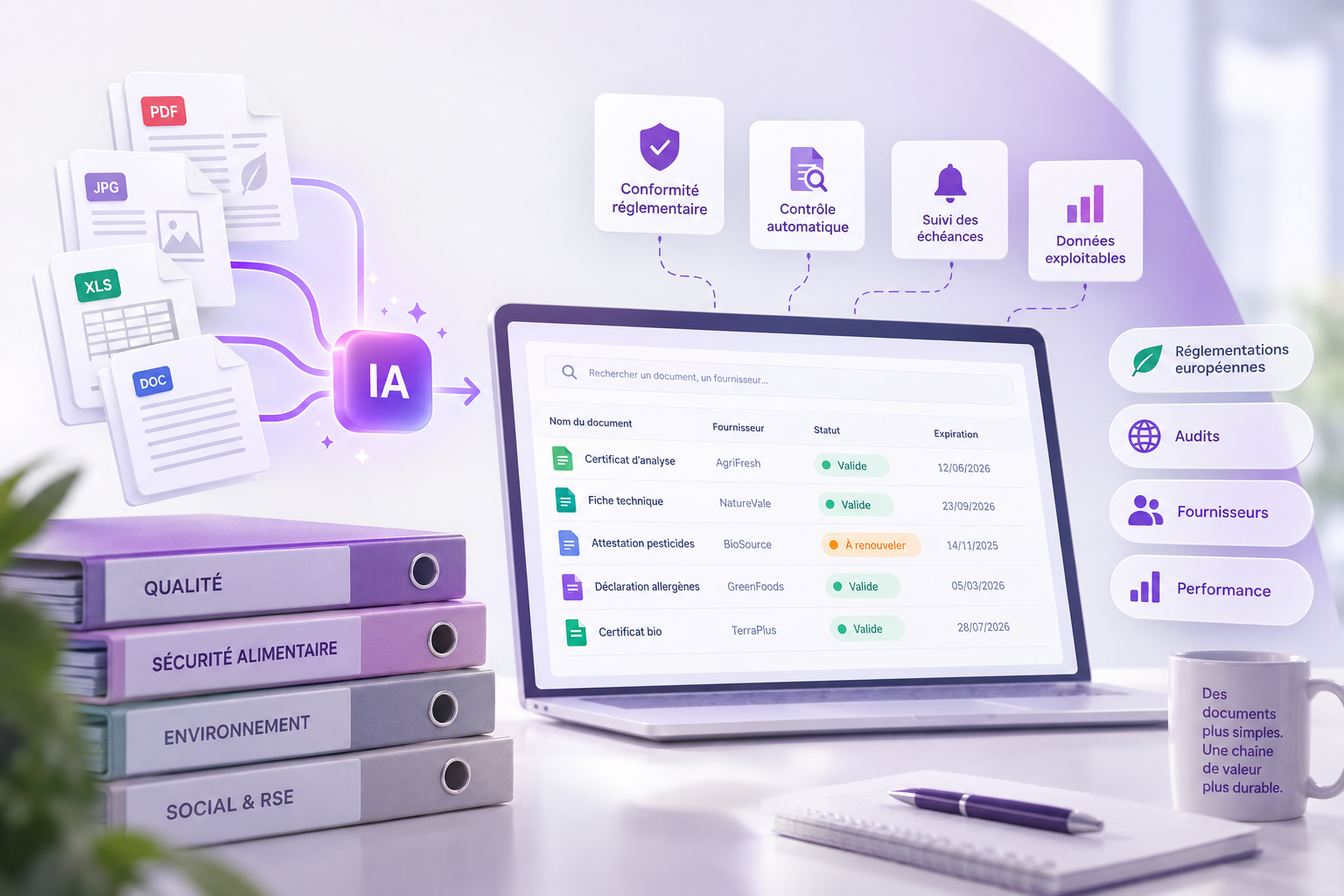
Regulatory document management covers all the processes used to collect, organize, keep up to date, and track the documents required by quality standards and legal obligations. For manufacturers and food industry companies, poor document management can lead to audit non-conformities, contractual penalties, and the loss of strategic customers.
This guide explains which documents need to be managed, the main operational challenges companies face, the best practices to implement, and the criteria to consider when choosing the right tool for supplier document management.
1. Why Regulatory Document Management Is a Critical Issue for Manufacturers
In a market where quality standards continue to multiply and customers increasingly demand full traceability across their supply chains, document management is no longer simply an administrative requirement. It has become an operational lever that directly affects a company's ability to manufacture, sell, and grow.
The Risks of Poor Document Management
A missing, expired, or unavailable document during an audit can have immediate and long-lasting consequences:
- Failed audit: a major document-related issue, such as an expired supplier certificate or an outdated procedure, can result in a critical non-conformity and potentially the loss of certification.
- Contractual penalties: major retailers and industrial customers often include document compliance requirements in their contracts. Failure to comply may result in financial penalties or suspension from the approved supplier list.
- Loss of customers: a supplier that cannot demonstrate compliance quickly loses credibility. In tenders, an incomplete compliance file can be grounds for immediate disqualification.
- Product risk: an outdated certificate of analysis or an incorrect technical specification may result in a non-compliant product being placed on the market, with the legal liabilities that this entails.
What Standards Require: IFS Food, BRC, GFSI and GDPR
The main standards applying to the food and manufacturing sectors impose specific document management requirements that are assessed during audits.
IFS Food v8 requires end-to-end control of documentation: procedures, records, evidence of compliance, and supplier documents must be available, up to date, and readable. Approval of a supplier providing outsourced processes must be based either on a GFSI-recognized certification or on a documented audit covering food safety, quality, and authenticity.
BRCGS Food Safety requires a supplier approval process based on a documented risk assessment, combined with ongoing supplier performance monitoring. Every supplier approval decision must be traceable and supported by documentary evidence.
GFSI (Global Food Safety Initiative) recognizes IFS and BRCGS as benchmarked certification programs and defines a common minimum framework, including an approved supplier list, evidence of approval, risk assessments, valid certificates, and non-conformity monitoring.
GDPR applies to personal data contained in supplier documents, such as contact details and employee information. The CNIL states that personal data should only be retained for as long as necessary for the purpose for which it was collected. In practice, contracts and commercial correspondence should generally be retained for five years, while accounting documents must be kept for ten years. A formal document retention policy is therefore essential for GDPR compliance.
2. Which Regulatory Documents Need to Be Managed?
Compliance document management covers two main categories of documents: documents received from suppliers and documents produced internally. Both need to be managed with the same level of rigor.
Supplier Documents
Supplier documents form the backbone of the supplier compliance file. They typically include:
- Product specifications: composition, physicochemical characteristics, storage conditions, and instructions for use. They must be kept up to date and accurately reflect the products supplied.
- Certificates of Analysis (CoA): evidence of batch-level compliance, often required for every delivery of critical raw materials.
- Supplier specifications and agreements: contractual documents defining the expected quality, safety, and regulatory requirements. Their signature and periodic update may be required under IFS and BRCGS frameworks.
- Statements and certifications: IFS, BRCGS, ISO 22000, organic, halal, and other certifications. Each certificate has an expiry date that must be actively monitored.
- Supplier risk assessments: internal documents formalizing the risk assessment performed for each supplier, as required by BRCGS.
- Supplier audit reports: when a supplier does not hold a GFSI-recognized certification, a documented audit may be required as an alternative form of approval.
Internal Documents
Alongside supplier documentation, companies also need to manage their own regulatory and quality documentation:
- Quality procedures and work instructions: the current version must be accessible to all relevant employees, while obsolete versions must be archived.
- Quality records: inspection records, non-conformity reports, management review minutes, and other evidence demonstrating that the quality management system is operating effectively.
- Food Safety Management Plans and HACCP plans: living documents that must be updated whenever there is a change in process or formulation.
- Training records: evidence showing that employees have been trained on the procedures currently in force.
3. The 5 Major Challenges of Document Management in Industrial Companies
As compliance requirements continue to increase, quality and procurement teams face recurring issues that weaken document control on a daily basis.
1. Documents Are Scattered Across Multiple Channels
Supplier documents arrive by email, supplier portals, post, or messaging applications. They are then stored in individual inboxes, unstructured shared folders, or even physical binders.
This fragmentation makes it extremely difficult to obtain a consolidated view of supplier compliance status.
2. Version Control Is Poorly Managed
Without a proper version management system, multiple versions of the same document may coexist. An employee may unknowingly work from an outdated technical specification.
During an audit, presenting the wrong version of a document can result in an immediate non-conformity.
3. Manual Follow-Ups Are Time-Consuming
Following up with each supplier to obtain a renewed certificate or an updated technical specification is repetitive and time-consuming.
Without automated document workflows, reminders are often forgotten until an audit approaches.
4. Companies Are Not Always Audit-Ready
Being audit-ready at all times, rather than only during the weeks leading up to an audit, is the objective promoted by most standards.
In practice, many quality teams still spend days reconstructing document files before each audit. This is usually a sign that document management is not fully under control.
5. Supplier Traceability Is Incomplete
Knowing which document was received, when it was received, who reviewed it, which version was used, and what decision was made on the basis of that document is what creates an effective audit trail.
Without complete supplier traceability, it becomes difficult to demonstrate the rigor of the supplier approval process during a third-party audit.
4. Four Best Practices for Effective Regulatory Document Management
Building a robust regulatory document management system does not require reinventing existing processes. Four fundamental practices can significantly improve document control and make the system sustainable over time.
1. Centralize Documents in a Single Repository
Centralizing regulatory documents is the foundation for everything else.
A single repository, accessible to all relevant stakeholders such as quality, procurement, and production teams, eliminates document fragmentation and ensures that everyone works with the same information.
Centralization also makes updates easier: a document only needs to be updated once for all authorized users to immediately access the latest version.
2. Implement Strict Access Controls
Not every employee needs access to every document.
Role-Based Access Control (RBAC) helps protect sensitive information, reduce the risk of unauthorized changes, and support GDPR requirements related to data access minimization.
Every action, including document viewing, modification, and approval, should be recorded in a timestamped audit trail.
3. Automate Document Workflows
Document workflow automation transforms manual processes into structured workflows.
Examples include:
- automatically requesting documents during supplier onboarding;
- sending expiry alerts a set number of days before a document becomes invalid;
- routing documents through approval workflows with notifications;
- automatically archiving obsolete versions.
Automation reduces the risk of missed actions, accelerates approval cycles, and allows quality teams to focus on higher-value tasks.
4. Define a Document Retention Policy
Every document type should have a defined retention period aligned with legal obligations and applicable standards.
For example:
- commercial contracts and correspondence are generally retained for five years;
- accounting documents are retained for ten years.
A formal retention policy supports both GDPR compliance and effective audit preparation.
It should also define how documents are securely archived and how they are deleted at the end of their retention period.
5. General-Purpose DMS vs. Specialized Supplier Solution: Why Manufacturers Need More
Many industrial companies have already invested in a Document Management System (DMS) or a general-purpose document management tool.
These systems generally cover basic requirements such as storage and version management, but their limitations quickly become apparent when companies need to manage document exchanges with dozens or hundreds of suppliers.
| Criterion | General-Purpose DMS | Specialized Supplier Solution |
|---|---|---|
| Supplier document collection | Manual, via email or file import | Automated via supplier portal or AI-powered collection |
| Expiry alerts | Not available or manually configured | Native and configurable by document type |
| Supplier audit trail | Partial, mainly covering internal user actions | Complete: every supplier interaction is tracked |
| Critical data extraction | Not available | AI automatically extracts key data from documents |
| Compliance dashboard | Not available or generic | Real-time view by supplier, product family, and standard |
| IFS / BRC / GFSI compliance | Not native and requires complex configuration | Designed to support the requirements of these standards |
The difference is not only functional. It is strategic.
A general-purpose DMS treats documents as files. A specialized supplier solution treats them as business data that can be used to manage supplier compliance in real time.
6. How Tracklab Centralizes and Automates Supplier Document Compliance
Tracklab is a centralized supplier and product data management platform designed specifically for manufacturing and food industry companies.
It directly addresses the five challenges described above by combining centralization, automation, and artificial intelligence within a secure environment.
Automated Supplier Document Collection
Tracklab automatically sends document requests to suppliers during onboarding and whenever a renewal is required.
Suppliers can submit their documents through a dedicated portal. The documents are then added directly to the centralized repository without manual re-entry or documents being lost in email inboxes.
Configurable Expiry Alerts
Each type of document, such as an IFS certificate, BRCGS certificate, certificate of analysis, or allergen statement, can have an expiry date monitored in real time.
Automatic reminders can be sent to both quality teams and relevant suppliers a defined number of days before the expiry date, reducing the risk of an expired certificate going unnoticed.
AI-Powered Extraction of Critical Data
Tracklab's artificial intelligence automatically extracts key information from received documents, including:
- validity dates;
- analytical values;
- declared allergens;
- batch numbers.
This information is structured and made directly usable within the platform, removing the need to manually read and re-enter information from each document.
Complete Audit Trail
Every action performed on a document, including receipt, approval, rejection, modification, and archiving, is recorded with a timestamp and the identity of the user.
This comprehensive audit trail makes it possible to respond quickly to IFS or BRCGS auditor requests without having to manually reconstruct the documentation history.
Real-Time Compliance Dashboard
Tracklab provides a consolidated view of document compliance by supplier, product family, and standard.
Quality and procurement teams can immediately identify suppliers requiring attention and prioritize actions without manually cross-referencing multiple Excel spreadsheets.
Would you like to see how Tracklab could work for your use case? Request a Tracklab demo and discover how our industrial customers have reduced their audit preparation time by more than 60%.
7. FAQ — Regulatory Document Management
What Is Regulatory Document Management?
Regulatory document management covers all the processes used to collect, organize, update, secure, and track documents required by quality standards such as IFS, BRCGS, and GFSI, legal obligations such as GDPR and commercial law, and contractual requirements from customers.
It includes both supplier documents, such as certificates, technical specifications, and supplier agreements, and internal documents such as procedures, quality records, and HACCP plans.
Which Supplier Documents Are Required for IFS or BRCGS Certification?
For IFS Food or BRCGS certification, key supplier-related documentation may include:
- an approved supplier master list;
- evidence of approval for each supplier, such as a valid GFSI-recognized certificate or a documented audit report;
- a formalized risk assessment;
- certificates of analysis for critical raw materials;
- up-to-date technical specifications;
- signed supplier specifications or agreements;
- allergen declarations.
Monitoring of non-conformities and periodic supplier reassessments is also required.
How Can You Prepare for a Document Audit Effectively?
Effective audit preparation relies on three principles:
Permanent audit readiness: documentation is continuously kept up to date rather than being prepared only shortly before an audit.
Complete traceability: every decision is documented and timestamped in an audit trail.
Centralization: all documents are available from a single location.
In practical terms, companies should maintain an up-to-date list of required documents by standard, monitor expiry dates, and ensure that the current versions of all documents are clearly identified.
Which Tool Should You Choose to Manage Supplier Regulatory Documents?
The right solution depends on the complexity of the supplier base and the standards that apply to the business.
A general-purpose compliance DMS can be sufficient for simple storage and version-control requirements.
For manufacturers subject to IFS, BRCGS, or GFSI requirements and managing a significant supplier base, a specialized solution provides essential native capabilities such as:
- automated document collection;
- expiry alerts;
- complete audit trails;
- AI-powered data extraction;
- compliance dashboards.
The main selection criteria should include:
- alignment with relevant standards;
- ability to manage supplier workflows;
- traceability of actions;
- ease of deployment.
How Can Supplier Document Management Be Reconciled With GDPR?
Supplier documents often contain personal data, such as contact details for sales representatives or other supplier contacts.
GDPR requires organizations to define retention periods that are proportionate to the purpose for which the data is processed.
As a general principle:
- commercial contracts and correspondence are retained for five years;
- accounting documents are retained for ten years.
The CNIL recommends formalizing these rules within the organization's record of processing activities.
In practice, the document management system should support automatic archiving and secure deletion at the end of the document lifecycle while maintaining a traceable record of deletion operations.
Useful Sources
- IFS Food v8 — Official Standard
- BRCGS Food Safety — Documentation Kit
- CNIL — Data Retention Periods
- Service-Public.fr — Legal Retention Periods for Business Documents
- France Num — Electronic Document Management
Take control of your supplier data.
See how Tracklab centralizes, validates and keeps your supplier and product data up to date, so your teams can work faster with reliable information.
See Tracklab in action
Our latest news



Platform
Resources
You have subscribed to our newsletter thank you!
Oops! Something went wrong while submitting the form.