Choosing a PPWR service provider comes down to settling a concrete question: who produces the compliance evidence for your packaging, SKU by SKU? Regulation (EU) 2025/40 has applied since 12 August 2026, and the effort required of manufacturers is first and foremost documentary. Three families of players offer PPWR support - the consultancy, the SaaS platform and the EPR integrator - and they do not meet the same need. Here is how they compare, a matrix mapping company profile to provider type, the cost structures to anticipate and the questions to ask before signing.
In brief: which PPWR provider for which profile
- Need for a written regulatory opinion (ambiguous packaging category, export outside the EU, audit preparation): consultancy, on a bounded scope.
- Need to collect and prove across a large portfolio: SaaS platform, with configuration of requirements and migration of existing data.
- Need to declare tonnages and pay eco-fees : EPR integrator, country by country.
- Most common combination in mid-sized companies : the platform as the evidence base, the consultancy for one-off decisions, the integrator for declarations.
- The decision rule : a provider should be judged on its ability to retrieve, for a given item of packaging, its composition, its recycled content and the declaration covering them - with the date and version.
What support must cover since 12 August 2026
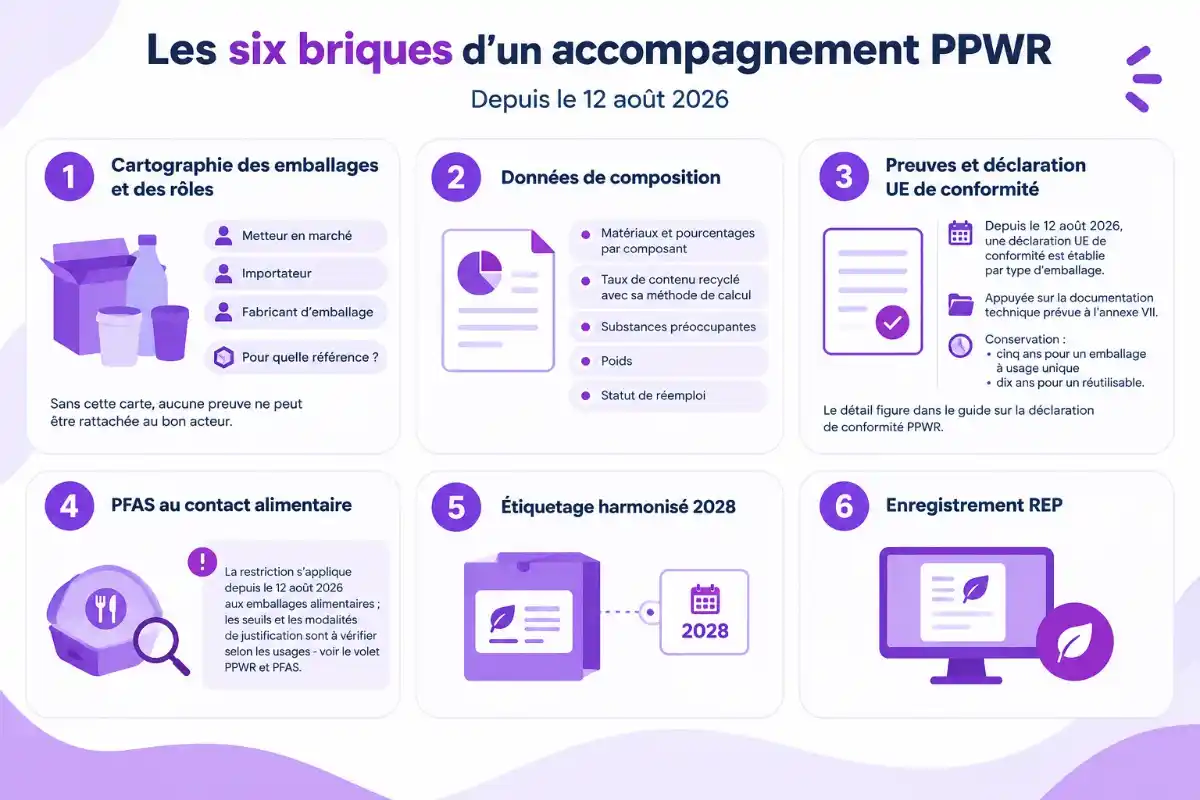
PPWR packaging rules cover three categories - sales, grouped and transport packaging - and each carries its own requirements. Credible support must therefore cover six building blocks, without skipping any.
- Map packaging and roles. Who is the producer placing on the market, the importer, the packaging manufacturer, for which SKU? Without this map, no evidence can be attached to the right party.
- Collect composition data. Materials and percentages per component, recycled content with its calculation method, substances of concern, weight, reuse status.
- Build the evidence and the declaration. Since 12 August 2026, an EU declaration of conformity is drawn up per packaging type, supported by the technical documentation set out in Annex VII. It must be kept for five years for single-use packaging and ten years for reusable packaging. Details are in the guide on the PPWR declaration of conformity.
- Address PFAS in food-contact packaging. The restriction has applied to food packaging since 12 August 2026; thresholds and substantiation methods should be checked for each use - see the section on PPWR and PFAS.
- Prepare labelling. Harmonised label on 12 August 2028 (or twenty-four months after the implementing act if it comes later), specific label for reusable packaging on 12 February 2029.
- Secure EPR. Article 44 requires registration in each Member State where the packaging is first made available, before it is made available. In France, the general commercial packaging scheme is announced as operational on 1 January 2027; 2026 remains a year of preparation and membership.
On top of this comes anticipation: on 1 January 2030, design for recycling becomes a condition for placing on the market (class C minimum) and minimum recycled content rates apply to plastic packaging: 30% for PET food-contact packaging, 10% for other plastic food-contact packaging, 30% for single-use plastic beverage bottles and 35% for other plastic packaging (Article 7). Classes A and B become the norm in 2038. The PPWR regulation: packaging compliance guide details this timeline.
In other words, support that stops at reading the text leaves the main task to you: producing the evidence.
Consultancy, SaaS platform or EPR integrator: the comparison
The three families are not substitutes for one another: they cover different links of the same chain. A PPWR consultancy provides the reading of the text and the written position; a platform provides the repository and the collection; an EPR integrator provides registration and the declaration of tonnages.
| Family | What it provides | What it does not do | Suitable profile | Cost structure |
|---|---|---|---|---|
| Consultancy (PPWR consultant) | Reading of the regulation, written position, compliance plan, audit preparation | Collecting and updating evidence day to day, maintaining a document repository | Initial scoping, ambiguous cases, multi-country organisations | Fixed project fee or person-days; the highest level for an equal scope |
| SaaS platform (compliance repository) | Data centralisation, supplier portal, reminders, AI extraction, deadline tracking | Signing the declaration, settling a regulatory interpretation | Large portfolio, quality team already structured | Annual subscription and configuration; the most predictable |
| EPR integrator | Membership, registration, declaration of tonnages, eco-fee monitoring | Proving composition per SKU, intervening in product design | Company placing packaging on the market in several countries | Eco-fee proportional to tonnages, plus a declaration service fee |
Two mistakes come up often. Entrusting a consultancy with collecting thousands of documents: the engagement becomes prohibitively expensive and falls outside its core business. Buying a platform without prior scoping: the tool works, but the configured requirements do not match your packaging categories.
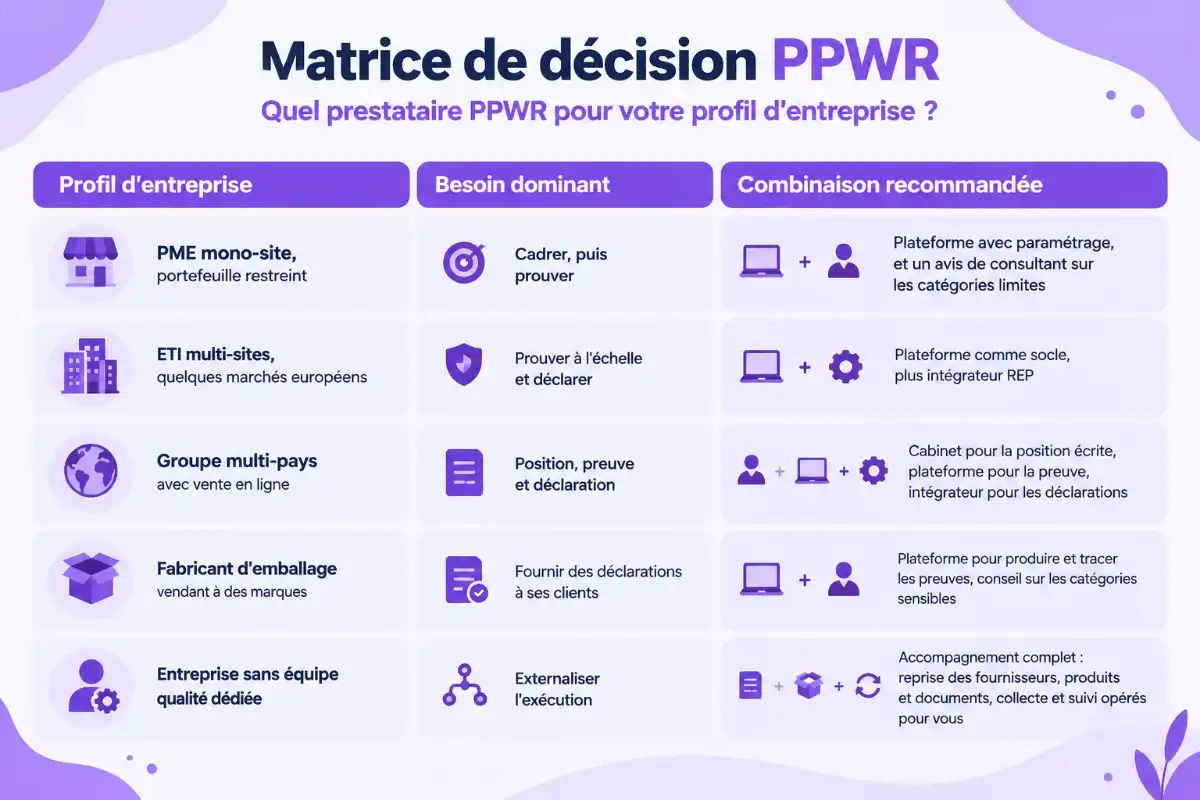
Which PPWR provider for your company profile?
The right choice depends less on the sector than on three variables: the number of SKUs, the number of countries where products are placed on the market and the availability of an in-house quality team.
| Company profile | Main need | Recommended combination |
|---|---|---|
| Single-site SME, limited portfolio | Scope, then prove | Platform with configuration, plus a consultant's opinion on borderline categories |
| Multi-site mid-sized company, a few European markets | Prove at scale and declare | Platform as the base, plus an EPR integrator |
| Multi-country group with online sales | Position, evidence and declaration | Consultancy for the written position, platform for the evidence, integrator for the declarations |
| Packaging manufacturer selling to brands | Provide declarations to its customers | Platform to produce and trace the evidence, consultancy on sensitive categories |
| Company without a dedicated quality team | Outsource execution | Full support: migration of suppliers, products and documents, collection and follow-up operated for you |
For this last profile, the challenge is workload, not expertise. Regulatory supplier traceability shows how much the evidence depends on the supplier relationship, often at several tiers of the chain.
How much does PPWR support cost?
No serious provider can display a single price: the cost depends on the scope, and the scope varies considerably between a single-site SME and a multi-country group. Four parameters account for most of the bill:
- the number of packaging SKUs to document, components included;
- the number of suppliers to contact and their geographical spread;
- the number of countries where products are placed on the market, and therefore of EPR registrations and declarations;
- the quality of the starting data : an up-to-date product repository greatly reduces migration time.
Cost structures differ by family. The consultancy bills expert time, as a fixed fee or in person-days: it is the heaviest expense for an equal scope, but it is bounded. The platform combines an annual subscription with initial configuration: the expense is more predictable, and it includes the migration of existing suppliers, products and documents. The EPR integrator bills a declaration service fee, to which is added the eco-fee, proportional to the tonnages placed on the market. The mechanism is described in the guide on commercial packaging EPR.
A useful trade-off is to compare the following three levels of commitment, from the lightest to the most comprehensive: a scoped project on one packaging family and one country; a full portfolio with active collection from suppliers; a multi-country set-up including regulatory decisions and audit preparation. The total cost, however, can never be read from the provider's quote alone: it includes the internal time committed, manual reminders and the cost of evidence that cannot be found on the day of an inspection.
Tracklab does not publish a price list: the quote is built on the actual scope (number of suppliers, SKUs and countries, level of migration of existing data) and on the share of execution delegated. The support covers the complete chain - migration of suppliers, products and documents, configuration of requirements, collection, checks, reminders, AI extraction of data from documents and preparation of the evidence for the declaration. The declaration remains signed by the producer placing on the market, by regulatory design.
The 5 criteria and 5 questions for selecting a provider
A PPWR consultant should be chosen on evidence of method, not on a promise of compliance.
The five criteria
- Written scope. Who collects, who checks, who decides, who signs? A contract that does not state this clearly leaves the grey areas to you.
- Traceability of evidence. Each document must carry an issuer, a date, a version and a scope. Regulatory document management sets out the rules.
- The ability to link supplier, component, packaging and finished product. Without this link, it is impossible to isolate the packaging affected by a requirement.
- Multi-country coverage. EPR registration, declaration languages and national categories: to be checked before signing, not after.
- Reversibility. Your data and documents must remain exportable, in a readable format, at the end of the contract.
The five questions to ask before signing
- Who draws up and signs the declaration of conformity, and on the basis of what evidence?
- Can you show me, in a demo, the evidence for a real item of packaging in under five minutes?
- What happens when a supplier does not respond: which reminders, what escalation, what timeframe?
- How are requirements updated when an implementing act clarifies an obligation?
- What happens to my repository if we end the collaboration: full export, version history, return timeframe?
Frequently asked questions
PPWR service provider:
your questions.
How long must a PPWR declaration of conformity be kept?
Five years from placing on the market for single-use packaging, ten years for reusable packaging. The technical documentation follows the same period (Regulation (EU) 2025/40, Article 15).
Does the PPWR replace EPR?
No. The regulation reshapes extended producer responsibility within a European framework without abolishing it: registration remains territorial, Member State by Member State, and the eco-fee is still due. In France, the commercial packaging scheme is announced for 1 January 2027.
Is a SaaS platform enough to be compliant?
No. A platform builds the repository, collects and tracks the evidence; it does not sign the declaration and does not settle an interpretation. Compliance also requires validated data, a completed declaration, EPR registration and labelling that complies by its deadline. Scope questions are covered in the PPWR FAQ.
What budget should be planned for PPWR support?
Three items should be budgeted separately: consultancy (expert time, bounded by the engagement), the tool or evidence base (subscription and configuration) and EPR declarations (service fee plus an eco-fee proportional to tonnages). The level depends mainly on the number of SKUs, suppliers and countries, and on the quality of your starting data.
Sources
- Regulation (EU) 2025/40 of the European Parliament and of the Council of 19 December 2024 on packaging and packaging waste, published in the Official Journal of the European Union on 22 January 2025 (Article 15 for retention, Article 44 for registration, Annexes VII and VIII for the technical documentation and the declaration template).
- European Commission, "Packaging waste" page (environment.ec.europa.eu), accessed 9 November 2026.
- ADEME, commercial packaging EPR scheme and unique identifier (SYDEREP), accessed 9 November 2026.
Cost ranges are deliberately kept qualitative: no amount is attributed to any third-party provider. For an order of magnitude for your case, the only reliable method is to have a precisely described scope priced - number of SKUs, suppliers and countries.
Want to see how Tracklab builds and traces the PPWR evidence for your packaging, SKU by SKU?
Book a demo ↗Take control of your supplier data.
See how Tracklab centralizes, validates and keeps your supplier and product data up to date, so your teams can work faster with reliable information.
See Tracklab in action