

Digital Transformation
Mis à jour le
9/16/2026
16/9/26
How to choose and deploy supplier compliance software in an industrial SME: steps, pitfalls to avoid, and practical insights.
How to choose and deploy supplier compliance software: Key steps, common pitfalls, and practical tips for a successful project.

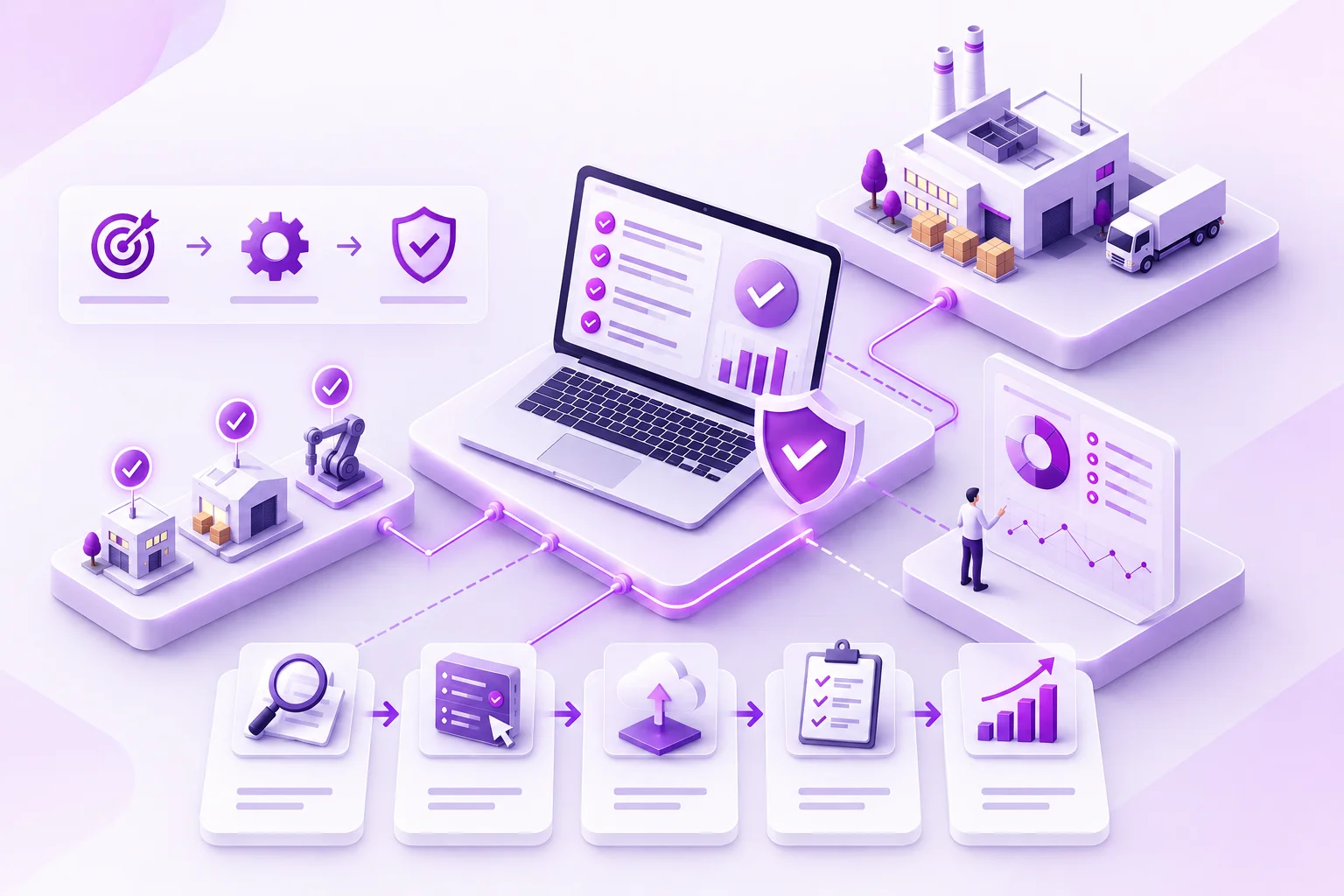
It’s 9:00 AM, five days before a client audit. The quality manager opens the supplier tracking spreadsheet and realizes three certificates have expired. Follow-up emails were sent two weeks ago, but no one replied. And the latest validated version of the document? No one on the team knows exactly where it is. This scenario is common in industrial SMEs, where supplier compliance often still relies on shared files, network folders, and untraceable email exchanges.
Which supplier compliance management software is most recommended for an industrial SME? This is the question quality and procurement teams are asking: how do you choose the right solution and deploy it without triggering a six-month IT project? This article provides the answer with specific functional criteria, an honest overview of available solution types, an illustrated case study, and an actionable roadmap.
Features that truly make a difference for an industrial SME
Not all solutions are created equal, and not all features are worth the same budget. Before evaluating tools, you need to know what really matters for your specific context.
Automated document collection: The top priority
An industrial SME typically manages between 50 and 300 active suppliers, each with certifications, attestations, safety data sheets, and declarations of conformity that must be renewed at different intervals. Without automation, this volume generates a workload of follow-ups and tracking that can take up dozens of hours per month for the quality team, depending on the scope. Good supplier compliance management software sends reminders based on rules you define, tracks acknowledgments, and centralizes submissions in a single repository without human intervention at every cycle. This is the most decisive feature for reducing operational burden.
AI-powered extraction: The game changer
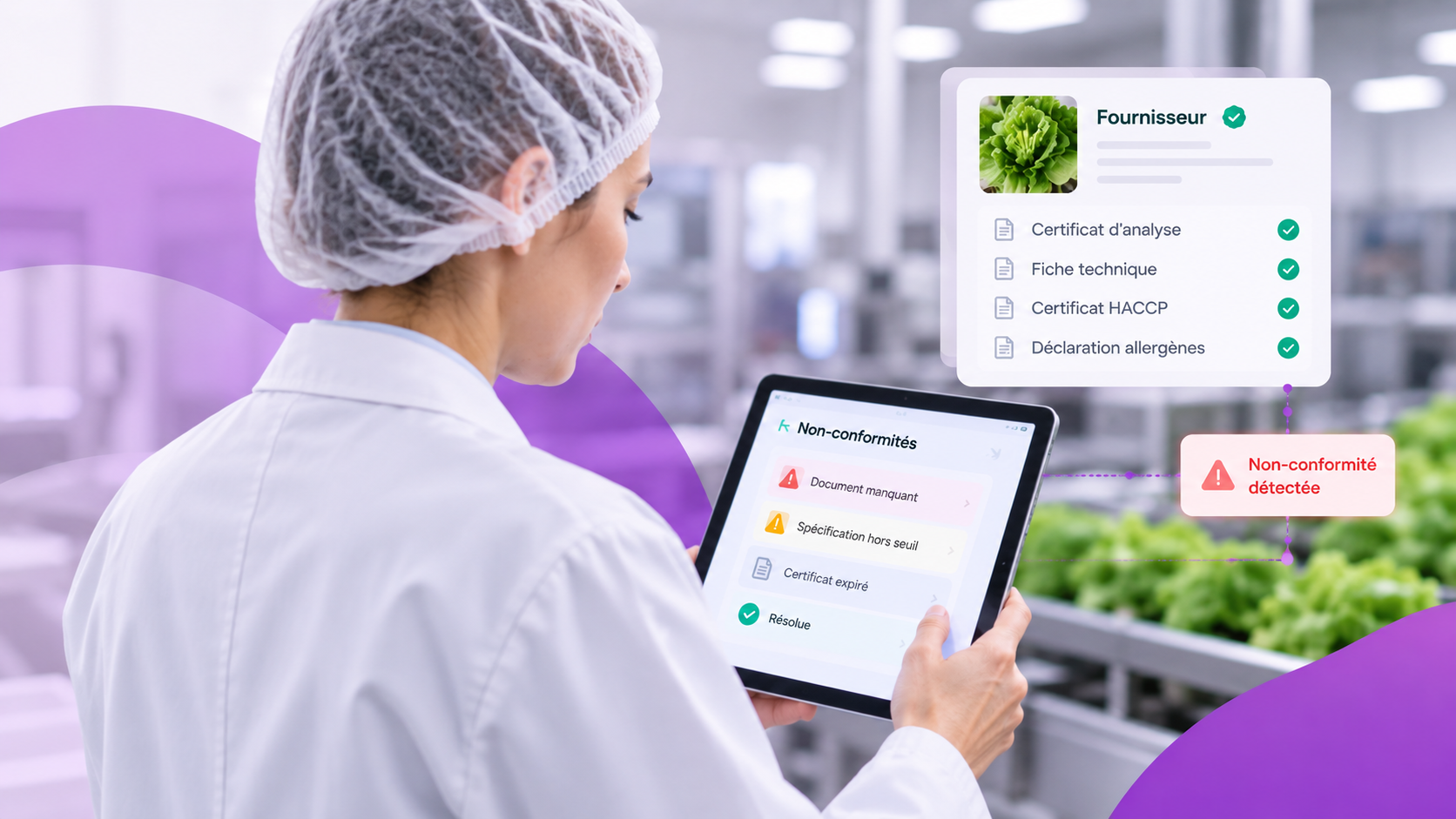
Software equipped with automatic extraction reads a PDF certificate, extracts the expiration date, covered standards, and scope, then triggers the appropriate alert. Compare this to a standard solution, where the user must manually enter this data after every document receipt. The difference in time and reliability is significant, especially in the food industry: IFS Food, BRC Global Standards, or organic certificates have strict validity cycles and numerous documentation requirements where the slightest data entry error can be costly.
Full traceability to pass audits without the stress
In software for tracking supplier non-conformities, traceability is not limited to document storage: you must maintain a history of versions, actions, approvals, and exchanges with each supplier. During an ISO audit or a client inspection, a clear dashboard with a complete history is worth hours of manual searching through email inboxes and network folders. A good tool allows you to generate an exportable report with all associated documents and evidence, turning audit preparation into a task that takes minutes rather than days.
Choosing supplier compliance management software: Regulatory requirements to include in your specifications
Supplier compliance is not just about documentation: it is governed by French and European regulations with precise requirements. Building your specifications without taking these into account risks leading you to choose an unsuitable tool.
REACH, CE marking, and concrete documentation requirements
The REACH regulation requires your suppliers to provide you with safety data sheets, substance declarations, and, in some cases, proof of registration with ECHA. For CE marking, your software must allow you to collect and verify declarations of conformity as well as the associated technical documentation. SMEs often underestimate the documentation burden these obligations create, especially when suppliers change formulations or production sites without notice.
Duty of vigilance, CSRD, and CSR requirements in the supply chain
Due diligence obligations are gradually extending to SMEs through their relationships with larger prime contractors. The CSRD requires sustainability reporting that includes value chain data; the duty of vigilance law requires documented prevention plans. The software you choose must allow you to collect CSR questionnaires, emissions indicators, and supplier contractual commitments without it becoming a side project managed in a separate tool. The simple rule: your solution must cover all your documentation obligations toward your suppliers in one single place.
Comparison: which supplier compliance software for industrial SMEs?
The market offers several major families of solutions with quite distinct profiles. Understanding the differences prevents you from ending up with a tool that is poorly calibrated for your reality.
Generalist solutions, document platforms, and specialized tools
Compliance modules integrated into ERPs (SAP, Oracle, Sage) are powerful but rigid, expensive to configure, and often oversized for an SME without a dedicated IT team. French document compliance platforms like Tracklab, Provigis, or Qualios are solid regarding the duty of vigilance and the collection of evidentiary documents; their AI automation capabilities vary by vendor and version. Platforms specialized in supplier management with integrated AI, such as Tracklab, are designed to industrialize document collection, extraction, and tracking, with deployment tailored for business teams. No family is bad in itself: it all depends on your supplier volume, regulatory complexity, and internal resources.
The six-axis evaluation grid for objective comparison
Here are the decisive technical criteria to evaluate for every supplier compliance management software you test:
- ERP integration: native connector or API available, without custom development
- Configuration without IT intervention: alert workflows and compliance rules are configurable by business teams
- Security and hosting: data hosted in Europe, user and team-based access management
- Supplier portal: accessible with lightweight authentication to facilitate document uploads without excessive friction
- Traceability and audit export: complete history of versions and actions, quickly exportable
- Deployment speed: a project exceeding two to three months risks requiring IT support that most SMEs do not have in-house
Why AI is changing the game for SMEs
Manual document data entry is often the biggest bottleneck for SME quality teams. When a platform automatically reads a document, extracts key information, and compares versions, it eliminates dozens of hours of data entry every month. That is exactly what Tracklab does: documents are read, classified, and compared to previous versions without human intervention. For an SME without dedicated document management resources, this automation makes the solution viable where a non-AI tool would remain a half-measure.
Tracklab in practice: what it looks like in a food processing SME
Features make more sense when you see them in a real-world context. Here is what Tracklab delivered for a representative client in the food industry.
The starting point: 150 suppliers, two quality staff, and regular audits
This food processing SME managed 150 ingredient and packaging suppliers with a two-person quality team. They underwent an IFS Food audit every 18 months and had to renew their organic and BRC certificates twice a year. Before Tracklab, management was handled via a shared folder and manual email follow-ups. The rate of up-to-date documents at the time of an audit never exceeded 70%, posing a real risk of non-compliance during every auditor visit.
Features enabled and results achieved
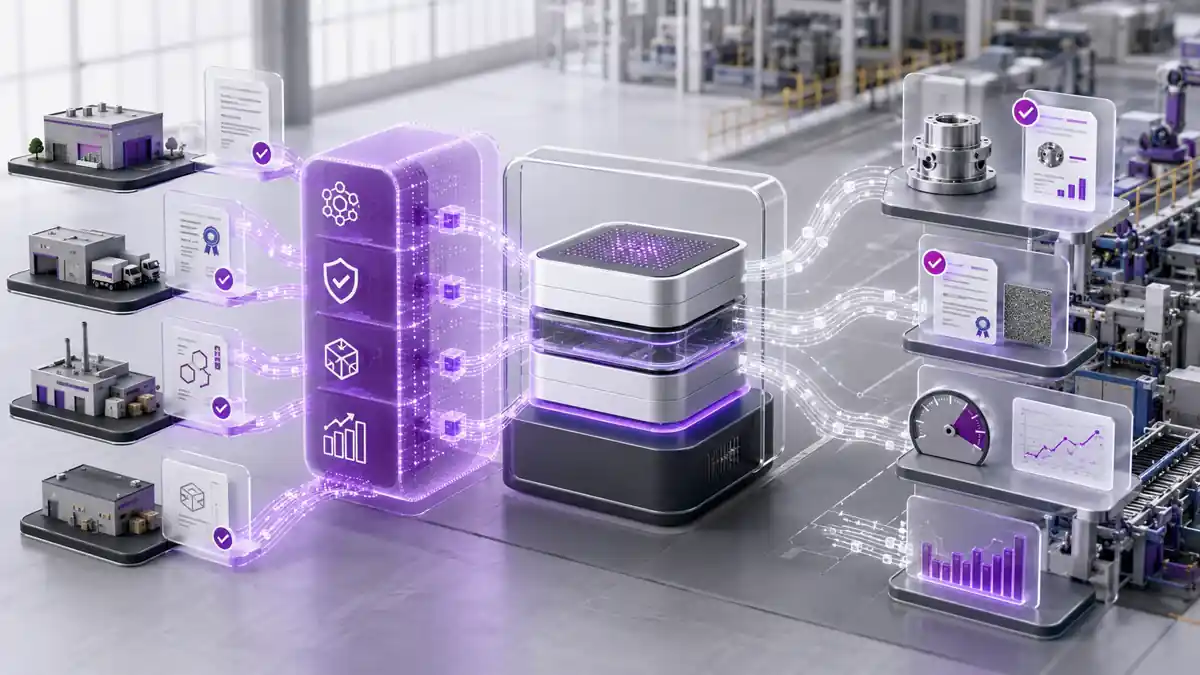
Tracklab centralized all documents into a single source, configured expiration rules by document type, activated automated follow-ups via a custom supplier portal, and launched AI-powered extraction of validity dates and covered certifications. Within a few months, the document compliance rate increased significantly, manual follow-ups were virtually eliminated, and the deployment was completed without involving the IT team. This structured approach—automated collection, intelligent extraction, and a dedicated supplier portal—is scalable regardless of the size of your supplier base.
Realistic costs and how to estimate your ROI
Before presenting a tool to your management, you need concrete figures to build a solid business case.
What a supplier compliance solution actually costs in 2026
For a French industrial SME, the typical price ranges are as follows:
- Annual subscription: between €2,000 and €10,000 depending on the number of suppliers and features
- ERP integration: from €0 to €5,000 depending on the complexity of the connector
- Initial training: between €500 and €3,000 in the first year, though this may be included in your package.
- Total first-year budget: between €5,000 and €25,000 depending on the scope
Solutions with integrated AI are positioned in the higher price range, but they generally pay for themselves faster thanks to time saved on data entry and follow-ups.
How to calculate your return on investment
Let's look at a concrete example: if your quality team spends 20 hours a month on follow-ups and document entry, valued at the employee's fully loaded cost, the annual savings often exceed the subscription fee. Add to this the avoided cost of a failed audit or a customer non-compliance issue, which can quickly amount to tens of thousands of euros, not to mention the reduced risk of supply chain disruption due to an undetected expired document. By combining these three factors, most industrial SMEs see a return on investment within the first year of use.
Deploy your supplier compliance software without involving the IT team
Choosing the right software shouldn't require a full-scale IT project to get up and running. Here is how to structure your deployment to move quickly and avoid common pitfalls.
The four steps to a successful implementation
Deployment follows four distinct phases, in this order:
- Map your document scope: identify supplier categories, required document types, and renewal frequencies.
- Configure compliance rules and alert workflows in the tool. Don't wait for perfection; you can refine your settings as you go.
- Migrate existing data and activate the supplier portal so your partners can upload their documents directly.
- Train your quality and purchasing teams in a short session focused on daily use cases.
The most common mistake is trying to cover your entire supplier base on day one. Start with one category, validate the process, and then expand gradually.
Pitfalls to anticipate before launch
Projects that stall usually fall into the same traps. Opting for an oversized tool with modules no one will use increases costs and hinders adoption. Cleaning up existing data is almost always underestimated: a list of 200 suppliers will always contain duplicates, incomplete entries, and expired documents that must be identified before any migration. Engaging suppliers is another often-overlooked step: if your partners don't understand what is being asked of them, submission rates will remain low, regardless of the tool's quality. Finally, clearly defining who approves what in the workflow is essential; without assigned rules, the software becomes a mere storage box rather than a true management tool. A well-structured deployment, designed for business teams without IT dependency, eliminates most of these obstacles from the start.
Conclusion: which supplier compliance management software is most recommended for an industrial SME in France?
The honest answer: there is no one-size-fits-all solution, but there are criteria that make the choice clear. For the majority of French industrial SMEs, the most suitable solution is a platform specialized in supplier compliance management, featuring AI-powered extraction, an integrated supplier portal, and a deployment accessible to business teams, provided it covers your actual regulatory obligations and integrates without a heavy IT project.
Tracklab illustrates what this combination looks like in practice: a platform designed for the quality, purchasing, R&D, and CSR teams of industrial SMEs, offering full document automation and a quick learning curve. Centralizing documents, automating follow-ups, and using AI extraction are not just extra features; they are the pillars of reliable and verifiable supplier management.
If you want to see how this works with your own supplier data, request a personalized demonstration. It is the best way to move from a checklist to an informed decision.
Take control of your supplier data.
See how Tracklab centralizes, validates and keeps your supplier and product data up to date, so your teams can work faster with reliable information.
See Tracklab in action
Our latest news

Platform
Resources
You have subscribed to our newsletter thank you!
Oops! Something went wrong while submitting the form.