Where
Netherlands
Activity
Agri-food & chemicals trading
Number of employees
100
Constraints
GFSI, multi-product & multi-supplier, demanding clients

-60% reduction in onboarding lead times
-80% reduction in regulatory order blocks
+40% in operational capacity


Will & Co is an international trader based in the Netherlands, specializing in agri-food and chemical products.
Its business model relies on speed, the ability to secure complex flows, and to seize market opportunities that are often time-sensitive.
In this context, supplier compliance is not just a quality topic — it is a direct driver of commercial performance.
Before Tracklab, Will & Co faced several critical limitations:
These constraints had a direct impact on revenue, margins, and customer credibility.
Will & Co deployed Tracklab to turn compliance into a smooth, predictable process that actively supports commercial activity.
Today, the platform enables Will & Co to:
Tracklab is used as an operational decision-making tool, not just a document management system.
With Tracklab, Will & Co clearly shifted its operating model:
Compliance is no longer a constraint on activity, but a lever for security and acceleration.
Today, Tracklab enables Will & Co to scale its operations without increasing risk exposure.
Structured and reliable supplier data provides a solid foundation to:
Will & Co now benefits from a decisive operational advantage in an ultra-competitive trading environment.
Simplify your management
Free your teams from reminders and spreadsheets. Track your compliance in real time, at scale.
Faites comme
William V.
,
choisissez Tracklab.
Libérez vos équipes des relances et des tableurs. Suivez votre conformité en temps réel, à grande échelle.
“Tracklab has transformed compliance from a cost center into a true performance lever.
We’ve gained visibility, reliability, and—most importantly—peace of mind, at a scale we had never reached before.”

How much does your IFS certification really cost you per year?
With Tracklab, simplify IFS monitoring, reduce costs and turn your certification into a real profitability lever.
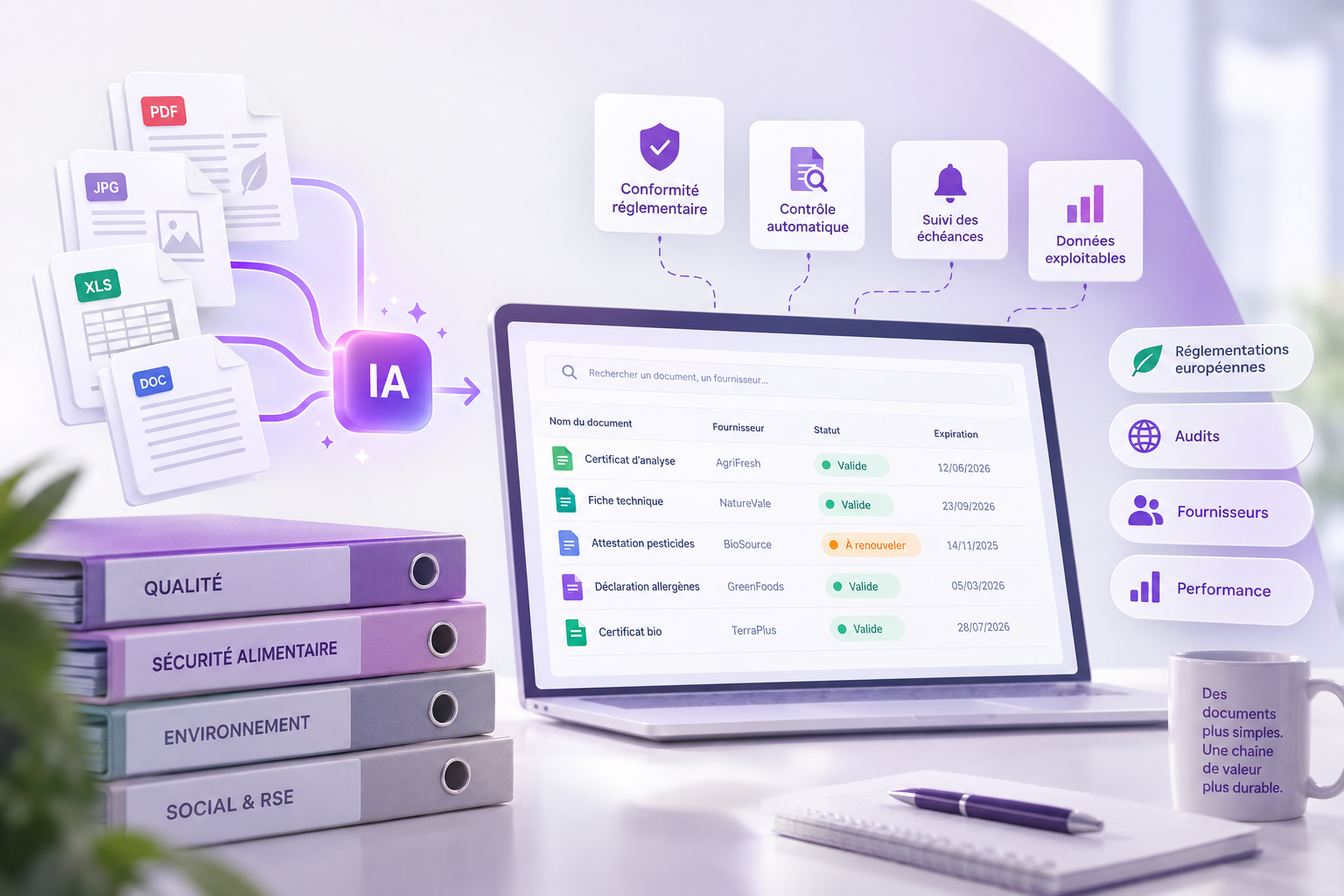
Regulatory Document Management: How to Centralize, Secure and Automate Supplier Compliance
From supplier certificates and technical specifications to compliance statements, audits, and renewal deadlines, regulatory document management can quickly become a major challenge for quality and procurement teams. Yet these documents are far more than an administrative burden: they directly impact compliance, traceability, operational continuity, and supplier risk management.

Why is supplier compliance a key lever for securing your supply chain?
Supplier compliance is essential to secure the food supply chain, by guaranteeing quality, traceability and risk reduction. Tracklab centralizes and automates the management of this compliance, allowing companies to strengthen their supplier relationships while optimizing their processes.
2026: Major Regulatory Disruptions in the Food Industry — and How to Prepare
The year 2026 marks a fundamental shift in compliance within the food industry. We are no longer dealing with an accumulation of regulations, but with a new operational framework in which the ability to prove, document, and continuously update information becomes critical. Companies that approach these topics as mere regulatory obligations are exposing themselves to major risks: commercial disruption, rising costs, and loss of customer credibility. Here are the key disruptions to anticipate — and, above all, how to prepare for them in practical terms.