Language


Product News
Mis à jour le
8/20/2026
21/9/26
Tracklab Insights: when your supplier database updates itself
Tracklab Insights automatically detects the impact of incoming supplier documents on your database—such as new allergens, changed origins, nutritional values, or certifications—tasks that quality teams previously had to perform manually, document by document. The result: reduced risk of non-compliance, time saved for your teams, and a database that remains continuously up to date.


The real problem: a database that ages with every document received
In the food industry, supplier data is never static. Technical data sheets are updated, raw material specifications change, certificates are renewed, and nutritional values are corrected. Every incoming document potentially carries a change that needs to be reflected in your internal database, PLM, or quality system.
The problem is that these changes arrive in a disorganized stream—via email, through a portal, or as a three-page PDF where only a single line has changed. It falls to your quality and procurement teams to spot that specific line.
Here is how it plays out in practice, without a dedicated tool.
Change detection happens by eye, document by document
A supplier sends a new version of a technical data sheet. Someone has to open it, mentally compare it to the previous version (if it can even be found), identify what changed, and then update the correct field in the right system. Multiply that by hundreds of supplier references, and you have a task that is never truly finished.
Most teams do not compare documents line by line; they simply do not have the time. They file the document, update whatever stands out, and move on to the next one. The rest is a gamble that nothing important has changed.
The cost in time and risk
First, the time. Manual entry and verification of supplier data represent a significant portion of the workload for quality and procurement teams—a task that is low in added value and high in tedium. It is repetitive, thankless work that ties up qualified staff with data entry.
Next, the risk, which is the most serious part. The errors that slip past manual controls are precisely the ones that cost the most:
- A newly declared allergen in a technical data sheet that is not carried over to your database. This leads to potential product recalls, health risks, and direct legal exposure.
- A change in the origin of a raw material, left undetected, that invalidates a label or a contractual commitment.
- A modified nutritional value that makes a label non-compliant without anyone noticing.
- An expired certificate or a lost standard (IFS, BRC, FSSC 22000) at a supplier, which puts you in breach during an audit.
These incidents almost never come from negligence. They come from volume. No one can manually re-read every document while cross-checking every field against its history. It is a structural limit of manual work, not a failure of the teams' diligence.
What Tracklab Insights does
Tracklab Insights reverses the logic. Instead of asking your teams to look for what changed, the system flags the changes and their consequences for you.
Automatic impact detection, not just reading
Plenty of tools can read a document and extract text from it. That is OCR, and it is a starting point, not a solution. The real difficulty is not reading a PDF: it is understanding that a changed line in that PDF has a consequence on a specific piece of data in your database, and qualifying that consequence.
That is what Tracklab Insights does. As soon as a supplier document arrives on the platform, the AI scans it automatically and compares it against the data already on file. It does not merely extract: it detects the discrepancies and qualifies them as impacts.
How it works, concretely
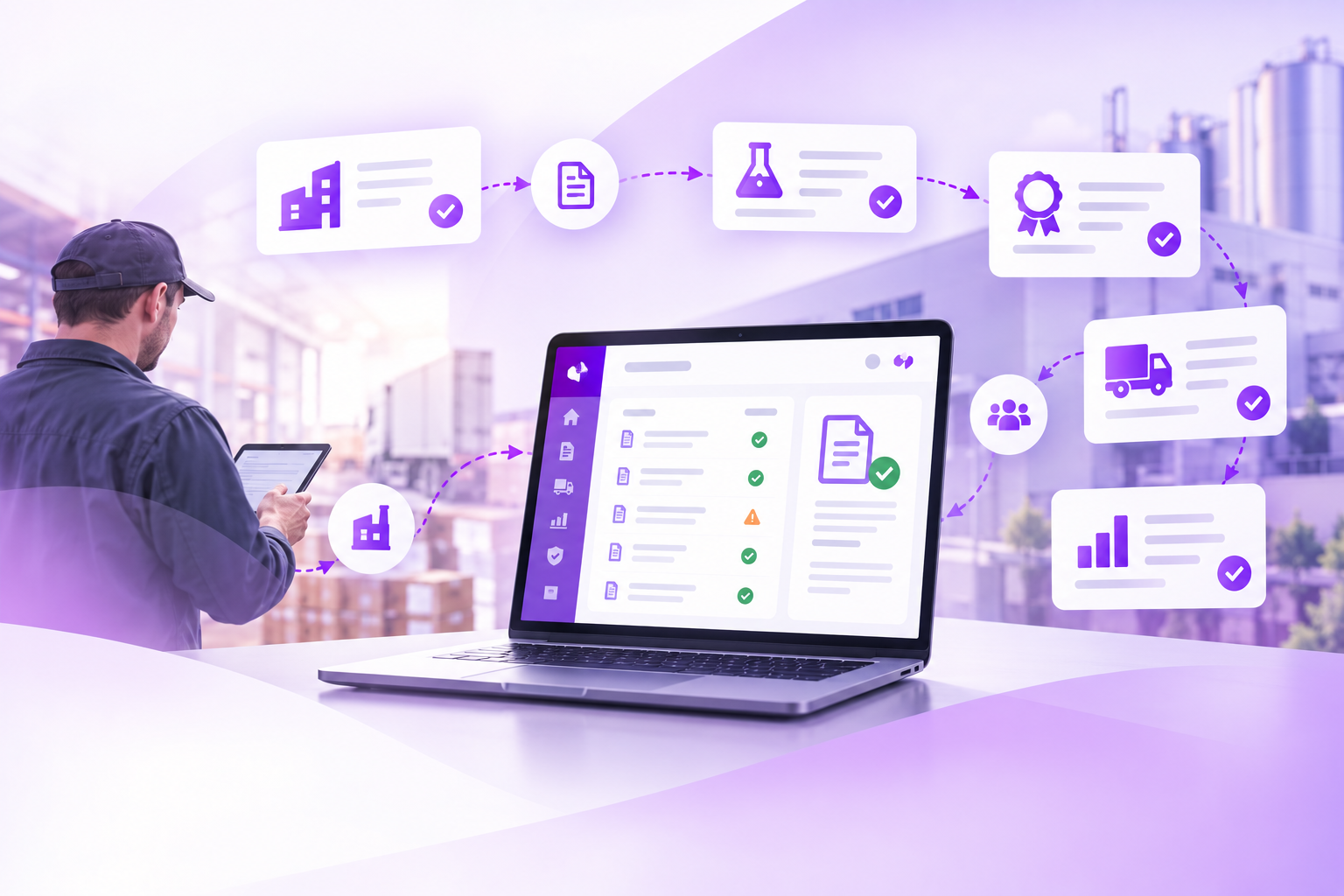
The process follows four steps:
- Reception. A supplier document arrives (technical data sheet, specification, certificate, laboratory analysis). No manual action is required to trigger processing.
- Analysis. The AI reads the document, extracts the structuring data, and compares it to the current state of your database.
- Impact detection. The system identifies what changed and, above all, what that change implies: an allergen not previously declared, a modified origin, a different nutritional value, a certification status that has shifted.
- Delivery. The impact is surfaced clearly, prioritized by criticality, ready to be validated or handled by your teams.
The key point: your teams no longer search. They decide. The work shifts from a low-value detection task to a high-value decision task.
A capability built on real R&D
Detecting a reliable impact requires understanding the documentary structure of the food industry, the diversity of supplier formats, and the way a piece of data translates from a document into a business field. This is not a simple call to a language model.
Tracklab Insights is the result of research and development carried out by our data and product teams, building on a foundation that already processes documents from more than 40,000 suppliers. Tracklab holds Young Innovative Company status, which attests to the genuine R&D effort behind it.
Our value does not lie in the underlying AI model, which is a commodity available to everyone. It lies in what we do with it in a precise business context: the depth of our supplier data, our knowledge of GFSI standards, and the ability to link a document to its concrete regulatory and quality consequences. That combination is what separates a useful impact detection from a plain text extraction.
The benefits for your teams
For a quality manager, a procurement lead, or food industry management, the value is measured on three axes.
Reduced risk. Critical changes (allergens, origins, nutritional values, certifications) no longer depend on one person's attention on a given day. They are systematically detected and surfaced. That is a direct reduction in the risk of recall, non-compliance, and failed audit.
Time given back to teams. The time spent comparing documents and re-entering fields is absorbed by the system. Your teams focus on decisions and judgment, not on data entry.
A genuinely up-to-date database. Data stops aging in silence. Every document received helps keep your database faithful to supplier reality, continuously.
Availability
Tracklab Insights has been available since summer 2026. If you manage supplier data in a regulated food industry environment and the manual updating of your database is a point of friction, this is the right moment to talk.
Contact us for a demonstration.
Take control of your supplier data.
See how Tracklab centralizes, validates and keeps your supplier and product data up to date, so your teams can work faster with reliable information.
See Tracklab in action
Our latest news
.webp)
Platform
Resources
You have subscribed to our newsletter thank you!
Oops! Something went wrong while submitting the form.